Showing posts with label ASCO. Show all posts

Thursday, June 4, 2026

Review of #ASCO26 - Gyn Cancer Oral Abstract Sessions, May 29th sessions

I did not attend ASCO in person this year but rather I watched sessions live.  When not available live I watched session On Demand the next day.  I continued the tradition I started when I attended meetings in person.  I posted on X (Twitter) summarizing and sharing slides from the presentations. 

The Oral Abstract Session for Gynecologic Cancers was held on Friday, May 29th. My focus what on ovarian cancer treatment research. ( Although there is one endometrial trial in this post) 

 Endometrial Cancer: Ruby Trial Dostarlimab + Chemo Abs 5501

 Ovarian Cancer  NRG GY018  Abs 5502

Ovarian Cancer ROSELLA trial  Abs 5503

 Late Breaking Abstract CHIPRO  LBA 5504

 Ovarian Cancer CHRONO Abs 5505


Distillation of these studies : 

Ovarian Cancer Phase 2 MIRV trial Abs 5506


I'll post over the next few days other ASCO sessions including - Rapid Oral Abstracts, Surgery vs NACT, and the Poster Session. 

Dee

Every Day is a Blessing!  

Friday, May 19, 2023

Prepping for ASCO 2023

The  ASCO Annual meeting begins two weeks from today! This year I will attend virtually. I'll miss interacting with so many amazing researchers and getting to network with some outstanding advocates in the Advocate Lounge. 

You will catch me tweeting from the Live sessions and retweeting attendee's tweets for those sessions which are On Demand. Once the On Demand sessions are over they will become available for me to watch online so I can tweet or summarize them on this blog.  

Be sure to follow #gyncsm, #ASCO23 and ASCO Featured Voices, to be announced shortly by ASCO.

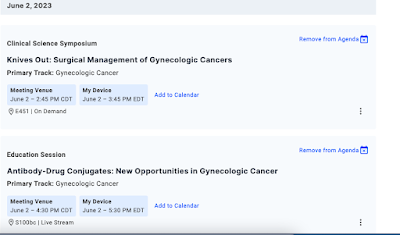
Since I am registered, I was able to set up an agenda using the Annual Meeting Program Guide https://meetings.asco.org/meetings/2023-asco-annual-meeting/299/program-guide.

 Here is my schedule so far: 

Friday 

 
Saturday 


Sunday

Monday 


There are also some sessions that are not specifically about gynecologic cancer that I've added to my agenda. 

On Demand session Improving Cancer Outcomes by Addressing Social Determinants of Health

On Demand Developing Sustainable Cancer and Aging Programs

On Demand Poster Discussion -Prevention, Reduction and Hereditary Cancer

There are a number of published abstracts/ articles in the ASCO 2023 Educational Book, which you can view at https://ascopubs.org/toc/edbk/current . You might want to check out  (e10035)  Patient Advocates and Researchers as Partners in Cancer Research: A Winning Combination if you are an advocate or researcher wanting to engage advocates in your research.

Be sure to check back during and after the meeting for blog posts on the topics / sessions I mentioned above. 

Are you an advocate who is presenting or on a panel? Let me know so I can be sure to watch. 

Dee 

Every Day is a Blessing! 

Wednesday, June 8, 2022

News from ASCO 2022 - Part 1 Gyn Cancer/ Survivorship Posters

The last post I wrote I was very excited to be going to Chicago to attend #ASCO22 Annual meeting. I had to change those plans after I started experiencing vertigo. My PCP advised me to not fly. So I cancelled my hotel and flight and switched gears to attend the meeting virtually.  

The set up for the virtual meeting this year allowed some sessions to be viewed live and other sessions would be available to watch On Demand later for those virtual attendees. The tech was not cooperating with me on Friday, most of Saturday until late on Sunday. I appreciate all the time that ASCO staff and IT spend with me trying to resolve my issue. In the future I will not use " in my name. 

Because of that delay, I will report on the posters which I could access first and then the other sessions. 

POSTERS  Gyn Cancer Research 

Interesting process for dispersing chemotherapy in the abdomen of women with OC

How sensitive is rucaparib in women with OC who do not have homologous recombination deficiency

Next Generation Sequencing in OC

BRAF, PIK3R1, NOTCH3,MET, and/or ATR correlated with shorter PFS 
ATM, RB1, CDKN2A, FGFR1, and/or FGFR2 associated with improved PFS 

Clear Cell Genomic Analysis

KELIM  - Algorithm that is calculated with 6 to 7 CA-125 values measured during the first 100 days after chemotherapy start

Suggests that bevicizumab is mainly effective in patients w/ poorly chemosensitive diseases. Highest benefit from bevacizumab in PFS and OS were high-risk diseases (stage IV, or incompletely.

Possible  biomarker test for OC uses extracellular vesicles

Posters Survivorship

 1 Frailty, 2 Cooling Caps, 3 Yoga, 4 Acupuncture for Neuropathy


 Stay tuned over the next few days for additional information on gyn cancer specific sessions. 

Dee

Every Day is a Blessing!

Tuesday, June 8, 2021

ASCO 2021 Oral Abstract Session - GYN Cancers

I'll begin my coverage of the #ASCO21 Annual  meeting I have been attending virtually with comments and tweets from the Monday June 7th Gyneocologic Cancer Oral Abstract session. 


Not all the studies report were "blockbuster", not all provided results the researchers expected but in each and every one of them we - researchers, clinicians and patients learned something. 

 Here is my tweet summary:  

OVARIAN CANCER

PDL1 inhibitor / Neoadjuvant chemo plus Bevacizumab

GEM vaccine  (Gemogenovatucel)

Bevacizumab 15 months vs 30 months 

Agent given to highlight tumors with overexpression of folate receptor Alpha during surgery

Mirvetuximab plus Bev for recurrent OC

Adavosertib w and w/out Olaparib

Endometrial Cancer 

Intensive Follow-up after endometrial cancer treatment

mTOR inhibitor and Anastrozole 

Pertuzumab and Trastuzumab in uterine cancer patients with ERBB2/ERBB3 


Over the next few days I'll be sharing tweets from the disparity, plenary ( cervical cancer study)  and poster sessions. Stay tuned. 


Dee

Every Day is a Blessing!

Sunday, June 7, 2020

Inspiration from #ASCO20

On this National Cancer Survivor's Day I am sharing two very inspiring speeches from the #ASCO20 Virtual Annual Meeting. One by Dr Skip Burris who was completing his year term as ASCO president and the other by Dr David Fajbenbaum, survivor, advocate and author of Chasing My Cure.

First some tweets from Dr Burris' speech.


Then Dr  Fajbenbaum spoke.


As Dr  Fajbenbaum completed his talk I imagined what it would have been like hearing him talk while sitting in the packed large hall in McCormick.  I am sure his speech would have been interupted countless times by clapping. And I am also sure my head would have been nodding in agreement along with so many other advocates and researchers in the audience.

As an almost 15 year survivor of Stage 3 Ovarian Cancer I do have Hope that working together we canfind improved treatments and insure all patients receive the health care they need.

Dee
Every Day is a Blessing!

Tuesday, February 4, 2020

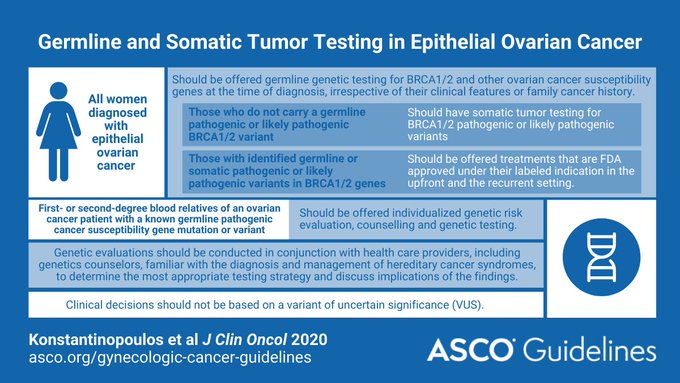
ASCO Releases the Germline and Somatic Tumor Testing in Epithelial Ovarian Cancer Guideline

On January 27, 2020, ASCO released the Germline and Somatic Tumor Testing in Epithelial Ovarian Cancer Guideline.  


Image
© 2020 American Society of Clinical Oncology, all rights reserved.


Recommendations from the ASCO website include:

"All women diagnosed with epithelial ovarian cancer should have germline genetic testing for BRCA1/2 and other ovarian cancer susceptibility genes

In women who do not carry a germline pathogenic or likely pathogenic BRCA1/2 variant, somatic tumor testing for BRCA1/2 pathogenic or likely pathogenic variants should be performed. 


Women with identified germline or somatic pathogenic or likely pathogenic variants in BRCA1/2 genes should be offered treatments that are US Food and Drug Administration (FDA) approved in the upfront and the recurrent setting. 

Women diagnosed with clear cell, endometrioid, or mucinous ovarian cancer should be offered somatic tumor testing for mismatch repair deficiency (dMMR). 

Women with identified dMMR should be offered FDA-approved treatment based on these results. 

Genetic evaluations should be conducted in conjunction with health care providers familiar with the diagnosis and management of hereditary cancer. First- or second-degree blood relatives of a patient with ovarian cancer with a known germline pathogenic cancer susceptibility gene variant should be offered individualized genetic risk evaluation, counseling, and genetic testing. 

Clinical decision making should not be made based on a variant of uncertain significance. 

Women with epithelial ovarian cancer should have testing at the time of diagnosis. "

You may read the complete guideline with recommendations and evidence from the 19 studies reviewed for the guideline at https://www.asco.org/research-guidelines/quality-guidelines/guidelines/gynecologic-cancer#/142631 

Dee
Every Day is a Blessing.

Tuesday, October 1, 2019

ASCO Advocacy Summit

I am a patient advocate member of ASCO and last week I joined oncologists and members of ASCO in Washington, DC as part of the ASCO Advocacy Summit. We had training  sessions on Wednesday and on Thursday we visited our Senators and members of the House of Representatives.
ASCO On the Hill.

I was paired with Dr Charles Miller from Hawaii so we visited the offices of both NJ and Hawaii legislators.

Visiting with Congressman Case (Hawaii)
The bills we asked our legislators to support:
HR 913 Clinical Treatment Act - We stressed the importance of participation by Medicaid patients in clinical trials and the stumbling blocks to participation they currently experience. Meidcaid insures one-fifth of the US population. Yet only 12 states currently allow Medicaid coverage of clinical trial routine care. In those states that cover clinical trials there has been a minimal effect on overall care costs. We asked that patients on Medicaid receive coverage for routine care when enrolled in a clinical trial.

HR 3107  Improving Senior Timely Access to Care Act - Seniors on Medicare Advantage plans are  experiencing delays in  medically necessary testing and treatment due to slow prior authorization policies. Denials are sent without explanations of the determination. We asked that a uniform e- authorization be created for Seniors on these plans and that an explanation of denial be provided so that timely access to care can take place.

HR 2279 / S 2546 Safe Step Act -  Step therapy protocols requires patients to try and fail medications suggested by the payer before the medication prescribed by the doctor can be used Allowing this process in cancer care would delay access to the best treatment for cancer patients and also increase side effects and reduce quality of life. I was happy to learn that Rep Bonnie Watson Coleman (NJ)  has already co-sponsored the House Bill. 

While I did not speak to Senators Booker, Menendez or Congresswoman Watson Coleman in person their aides were very interested in hearing how these bills would effect the people in New Jersey.

You may not be able to travel to DC to speak to your legislators but if any of these bills are important to you it is easy to reach out to your Senators or Congressmen via e-mail or phone and ask them to support the bills that are important to you.

Thank you ASCO for allowing me to be the voice of cancer patients in NJ.

Dee
Every Day is a Blessing! 


Saturday, May 4, 2019

Comment Period -Germline and Somatic Tumor Testing in Epithelial Ovarian Cancer guideline

ASCO develops practice guidelines for cancer treatment and care. Currently draft recommendations for the Guideline for Germline and Somatic Tumor Testing in Epithelial Ovarian Cancer  is open for comment. The public is invited to comment on the draft.

Here is information from ASCO  if you would like to read and comment on the draft rerecommendations -

ASCO invites interested stakeholders to submit comments on draft recommendations from the Germline and Somatic Tumor Testing in Epithelial Ovarian Cancer: ASCO Clinical Practice Guideline. 
To participate, interested reviewers can download the confidentiality agreement and email a signed copy to guidelines@asco.org to receive access to the survey containing the guideline recommendations. Comments will be accepted through Thursday, May 16. Learn more at www.asco.org/open-comment-guidelines.
 
Advocates, patients and caregivers may comment too.

Dee
Every Day is a Blessing!

Friday, November 2, 2018

Becoming a Research Advocate

Yesterday, I had a phone conversation with a stage 4 ovarian cancer survivor who was interested in becoming a research advocate. We met on Twitter and have followed each other for the past few months. She asked me questions about how I got started in advocacy and places she could go to prepare to  become a cancer research advocate. In  A Bit of Advocate in All of Us an article I wrote for SHARE 
(https://www.sharecancersupport.org/2017/01/a-bit-of-advocate-in-all-of-us/ ) I wrote about different types of advocacy. Today I want expand on that information I provided on  research advocacy. 

General Cancer Research Advocacy:

Research Advocacy Network - (http://researchadvocacy.org/)
RAN offers downloadable resources on topics such as those listed below that a research advocate can find beneficial.
Tutorial:Genomics in Cancer
Tutorial: Molecular Diagnostics in Cancer
Tutorial: Pathology and Tissue Research
Tutorial: Understanding Cancer Risk
Tutorial: Understanding Clinical Trial Design
Tutorial: Quality of Life and Patient Reported Outcomes
Tutorial: Biomarkers in Cancer

RAN also offers an online course on The Basics for Research Advocacy (https://researchadvocacy.org/advocate-institute/online-course-basics-research-advocacy )


AACR
The AACR (American Association for Cancer Research, www.aacr.org)  has programs specifically for research advocates.  I know a number of advocates, ovarian and other types, who have participated in the Scientist<-> Survivor Program at the AACR Annual Meeting."The program provides advocates with special lectures using lay language, small group discussions, and other opportunities for the exchange of information on key aspects of cancer research, survivorship, advocacy, and public policy." The deadline for the program at next year's AACR program is December 11,2018. Follow this link - https://www.aacr.org/ADVOCACYPOLICY/SURVIVORPATIENTADVOCACY/PAGES/ANNUAL-SCIENTISTHARR%3bSURVIVOR-PROGRAM-AT-THE-ANNUAL-MEETING___01696D.ASPX for more information and the online application. 

<->(https://www.aacr.org/patients-caregivers/patient-advocacy/)

ASCO / Cancer.Net
 The American Society of Clinical Oncology, ASCO , welcomes patient advocates as members at the Patient Advocate level (https://www.asco.org/get-involved/membership/member-benefits/patient-advocates). This membership allows patients/advocates access to savings on registration at meetings, magazines, guidelines and volunteer opportunities.  
The Foundation arm of ASCO is Cancer.Net. "The Conquer Cancer Patient Advocate Scholarship Program provides scholarships for patient advocates to attend ASCO-sponsored Symposia and the ASCO Annual Meeting to learn of important advances in their areas of interest. Scholarships help cover travel, hotel, and registration expenses and are based primarily on financial need, advocacy experience, and current advocacy activities and involvement." This link (https://www.cancer.net/research-and-advocacy/patient-advocates/conquer-cancer-patient-advocate-scholarship-program) will provide information on the 2019 meeting scholarships when the application period opens.

Ovarian Cancer  Research Advocacy Information 

Ovarian Cancer Research Alliance
OCRA (ocrahope.org ), formerly OCRFA,  provides information on various types of advocacy. On their Research Advocacy Page (https://ocrahope.org/advocacy/research-advocacy/)  you can read reports on research from their advocates who attend various medical conferences and meetings. While those who represent OCRA as Research Advocates are by invitation only, the stories of a few advocates such as Annie Ellis and Susan Leighton can provide additional ideas for roles you can play in supporting research.

OCRA also has a program known as Advocate Leaders which is a legislative advocates program. (https://ocrahope.org/advocacy/advocate-leaders/


FORCE 
Facing Our Risk of Cancer Empowered (http://www.facingourrisk.org/index.php)
"The FORCE Research Advocate Training (FRAT) Program is a basic educational course aimed at preparing people to become engaged in research advocacy on behalf of the hereditary breast, ovarian and related cancers community. " After filling out an application and being accepted into the Training program you take part in a number of webinars. You may learn more at http://www.facingourrisk.org/research-clinical-trials/research-advocate-program.php

I hope this helps other women get started as Research Advocates. If you know of other research advocate opportunities or training please let me know and I will update this page.

Thanks T for providing the spark I needed to write this blog post. 

Dee
Every Day is a Blessing! 

Updated 2022


Wednesday, October 25, 2017

I Took a Break

September,  Ovarian Cancer Awareness month is a very emotionally and physically draining month for me. I spend a good deal of time thinking about and talking about ovarian cancer - symptoms, treatments, statistics. I posted to this blog every day as well as shared information from other organizations  in daily promotions on Facebook and Twitter. I attended fundraising walks and other events to raise funds for ovarian cancer research.

In the middle of the month I had an appointment with my gyn onc for my 6 month check-up. I also had a CT scan since my CA-125 has been creeping. I dealt with so many emotions including the fear I might have recurred. The exam and CT report were good so I am set for 6 more months.

But during this month of ovarian cancer, I remembered. I remembered women who became my friends over the past 12 years who have died because of this disease - like Janice, Carol, Jane, Sherry and the list goes on. It made me angry and sad.

I know that when that happens I need to take a break. And that is what I did. I stepped away and concentrated on family ( visits with kids and grandsons)  and other non-cancer things such as beginning work on two paintings. I recharged my batteries to begin my advocacy work again.

And then last week,  I got this in the mail !


As a Patient Advocate Member of ASCO I was chosen as a 2016 Advocacy Champion - Speaker's Club for legislative advocacy work ( e-mails , tweets and blog posts)  that I did for ASCO on cancer research and funding issues in 2016. I don't do what I do to be recognized but it felt good to be appreciated.

If you are a patient advocate you should consider joining ASCO. You will be able to network with the top oncologists in the world and stay on top of the latest research in precision medicine.  Check out this membership page for more information https://www.asco.org/membership

I'll be posting more ovarian cancer research news in a few days.

Dee
Every Day is a Blessing!


Friday, December 30, 2016

Nine Years Ago

Has it really been nine years? I never thought when I started this blog on December 30, 2007 that I would be writing it so many years later. But here I am so here I write.

This year was not my most productive - this is my 41st post of the year. That is an average of only 3.4 posts per month.  In July I only wrote one post. In June,  I posted more than three because I couldn't wait to share all the research news I heard at the ASCO annual meeting. Attending that meeting as a survivor/ research advocate is a real privilege and I recommend that if you are a research advocate you apply for a scholarship to attend. Then in November I  tried the WEGOHealth Health Activist Writers Month Challenge but I ended up only writing seven posts. But I enjoyed the prompts that I did respond to.

My most popular posts of 2016 were:

So why did I blog less this year than any of the previous 8 years? I think it is due to an increase in my advocacy work over the past 12 months. I continue to  co-moderate the #gyncsm chat  (2nd Wed. of the month 9pm ET) and post on the communities blog (http://gyncsm.blogspot.com/).  This year we ran a survey so I worked with Christina ( @btrfly12) developing and analyzing the data from that survey to guide our future chats.We draft questions, invite guests, develop resources and promote this monthly chat as well as sharing on Twitter important developments of interest to the gynecologic cancer community on a daily basis. 

As a member of the  Board of the Kaleidoscope of Hope Ovarian Cancer Foundation, which raises funds for ovarian cancer research I oversee the social media (Facebook, Twitter) and the Foundation's website content.  I also volunteer with ASCO, serving as a patient representative on a tumor board and guideline panels.  Then I spent time in October working on a presentation and attending the AZ Patient Summit in Portugal. 

And of course time with family( always my first priority)  cut into the time I would spend writing blog posts. There are times I question whether or not I should continue writing this blog.  But I always come back to my original goal for the blog - to help other women diagnosed with ovarian cancer. Even if I help and support one woman a year I feel I've accomplished something.

So I will keep on writing.

Dee
Every Day is a Blessing! 


Wednesday, August 10, 2016

Neoadjuvant Chemotherapy Guideline for Advanced Ovarian Cancer

I was privileged to represent women diagnosed with ovarian cancer as the patient representative/advocate on the the joint SGO / ASCO guideline panel  that developed the recently released:

Neoadjuvant Chemotherapy for Newly Diagnosed, Advanced Ovarian Cancer: Society of Gynecologic Oncology and American Society of Clinical Oncology Clinical Practice Guideline

It was a process that took over a year, a few meetings (in-person and online), and many e-mails. During the entire time I felt that the "patient voice" was an integral part of the process. 

Thank you ASCO, SGO and Drs Alexi Wright and Mitchell Edelson, Guideline Chairs,  and the entire panel for giving me this opportunity. 

Dee
Every Day is a Blessing

Thursday, March 17, 2016

ASCO's The State of Cancer Care in America (2016) and Clinical Cancer Advances

I have been busy spending time with family the past few weeks. The blog posts should be more regular going forward. Thanks for understanding. 

ASCO ( American Society of Clinical Oncology) produces a number of important reports each year of interest to survivors, advocates and caregivers.

The State of Cancer Care in America 2016  reports on the trends in oncology care in the US. The report found that there is a  shortage of oncologists in rural areas, there remains inconsistent insurance coverage for cancer patients and the cost of cancer care continues to rise.
Below is an infographic which summarizes the information and recommendations made in the report. You may read the full report here.


The second report of importance to survivors is Clinical Cancer Advances 2016. For the past 10 years, ASCO has been producing this annual report. Earlier this year ASCO asked advocates and survivors to share how advances in research impacted their lives. You may read the report here.  I was honored to have my story chosen to appear in this year's report . You may find it on Page 41 ( 43 in a pdf reader).

Dee
Every Day is a Blessing!


Thursday, September 24, 2015

An Introduction to Genetics and Ovarian Cancer

When I was diagnosed with ovarian cancer I decided to learn as much as I could about the disease. While I was in treatment I was offered genetic testing for BRCA1 and 2 which I accepted. Our knowledge about the genetics of ovarian cancer has grown tremendously over the past ten years.

Let's start with this basic video from the NCI on genetics and cancer. 


Now let's talk about ovarian cancer in particular. 

About 15% of the ovarian cancers diagnosed are due to germline (inherited and passed on to offspring)  mutations in the BRCA1 and BRCA2 genes. Having these mutations increases the risk of ovarian cancer by 15-50%. “Nearly one-third of women with hereditary ovarian carcinoma have no close relatives with cancer, and 35% of women with hereditary ovarian carcinoma are older than 60 years at diagnosis”( NCI) .  The remaining ovarian cancers are due to what we call sporadic or somatic mutations. 

Following the BRCA mutations the next inherited syndrome that leads to ovarian cancer is Lynch Syndrome.  Mutations in the MLH1, MSH2, MSH6, PMS2 and EPCAM genes are linked to Lynch Syndrome.  Women who have Lynch syndrome have an estimated 9-12 % lifetime risk for developing ovarian cancer. (http://www.cancer.net/cancer-types/lynch-syndrome)

In June 2011, the The Cancer Genome Atlas (TCGA) Research Network issued the results of whole-exome sequencing of ovarian cancer tumors. They examinesd the protein-coding regions of the genome, of 316 ovarian cancer tumors. 

  
The study found :


21 percent of the tumors studied showed mutations in BRCA1 and BRCA2 

six other statistically recurrently mutated genes: RB1, NF1, FAT3, CSMD3, GABRA6 and CDK12. CDK12 is involved in RNA splicing regulation 

96% of ovarian cancers had a T53 mutation. T53 controls a tumor suppressor protein that stops cancer from forming

108 genes were associated with poor survival

85 genes were associated with better survival

68 genes that could be targeted by existing Food and Drug Administration-approved or experimental therapeutic compounds 

Four related subtypes of ovarian cancer based on the patterns of DNA methylation—a chemical reaction in which a small molecule called a methyl group is added to DNA, changing the activity of individual genes. 

The SGO released a Clinical Practice statement in 2014 stating that all women diagnosed with ovarian, tubal and primary peritoneal cancer regardless of age or family history should receive counseling and offered a genetic test. (https://www.sgo.org/clinical-practice/guidelines/genetic-testing-for-ovarian-cancer/ ) Knowing a women has a BRCA mutation may allow her to receive PARP inhibitor treatment . Olaparib was recently approved by the FDA to treat women with recurrent ovarian cancer. 

In August  ASCO issued an updated policy statement on genetic and genomic testing. ( http://www.asco.org/press-center/asco-releases-updated-policy-statement-genetic-and-genomic-testing-cancer

The more researchers understand the genetics of ovarian cancer the better they can  develop drugs to treat specific mutations and the more personalized women's treatment can become. 


Dee
Every Day is a Blessing! 

Additional Sources:

Lynch Syndrome and Ovarian Cancer
 
I Have Lynch Syndrome
 
 Ovarian Cancer : The Choice to Be BRCA Tested

Friday, June 12, 2015

ASCO Knowledge Part V: CancerLinQ

“Shoppers have Amazon.

Students have Google.

Oncologists will have CancerLinQ”

-CNN

That quote appeared on a brochure I saw at ASCO and it peaked my interest in a special patient advocate session that was being held to introduce us to CancerLinQ, a health information technology platform. In January of 2015, ASCO and SAP, a software company teamed up to create a Big Data software platform. 

ASCO’s Chief Medical Officer, Rich Schilsky began the session by sharing some important facts with the advocates.
Only 3% of adults participate in clinical trials. 
Older adults (>65)  may not qualify to participate in clinical trials so their outcomes and adverse effects may not be known by others who also treat older adults. 
As more drugs get approved through the quick FDA approval process there is a need to capture the knowledge that is being generated as patients use these drugs.  
Currently cancer patient data is in “silos”( my word choice) at various cancer centers – NCI centers, academic centers, and community oncologist groups.

 CancerLinQ will gather data from patients from around the country into a secure, searchable database. 

CancerLinQ In A Nutshell
Electronic Medical Records (EMR) of cancer patients will be collected, “de-identified” and entered into the database. Once the data is entered an number of things can take place:
-Providers can compare the care they provide to guidelines.
-Oncologists can search the database for patients with similar attributes, diagnosis, mutations, and treatments. The oncologists can then with their patients decide which treatment plan is best.
-Researchers can look for patterns in the patient data

In the fall of 2015, the first version of CancerLinQ will roll out and include 500,000 individual records from 15 oncology practices in the US. 

For more information please visit CancerLinQ.org


Dee
Every Day is a Blessing!

Monday, June 8, 2015

ASCO - Connections Part II - Twitter

In the last post, I wrote about the  face to face connections I made with advocates , oncologists and researchers at the ASCO Annual Meeting. But connections were made in other ways too. I made connections with others through twitter as I tweeted with the #gyncsm and #ASCO15 hashtags.

There were many people at the meeting tweeting research results to their followers as can be seen by the tweet stats posted by @ASCO.


Look at how the tweets increased as the meeting progressed. Below is a graphic of  how the number of #ASCO15 meeting Tweeters, Tweets, Impressions and avg tweets/hr differed from the 2014 annual meeting. 


People were not only tweeting to their followers but doctors were also interacting with patient advocates at and about the meeting . Greg Matthews (@chimoose) was able to capture these interactions visually one day during the meeting.

The physicians are blue dots and the yellow dots are patients. The size of the dot represents how many times that account was mentioned. Check out the yellow dot in the upper right quadrant. That's me, @womenofteal,  and my interactions with others at the meeting.  Thank you Greg for allowing me to use the chart in this post. You can view/ enlarge the chart by visiting this page. This chart was based on research by MDigitalLife"s  Social Oncology Report - http://MDigitalLife.com/socialoncology)

Coming up next are the first of a number of posts I call "ASCO: Knowledge"  which will report on the many studies that were reported on at ASCO.  

Dee
Every Day is a Blessing!

Thursday, May 28, 2015

Chicago, Here I Come!

Tomorrow I will be heading to Chicago for the American Society of Clinical Oncology (ASCO) Annual Meeting "Illumination and Innovation". I will be attending as a patient advocate and representing the #gyncsm( gynecologic cancer social media) Community on Twitter which I co-founded and co-moderate with Christina Lizaso.

I will be tweeting using the #gyncsm hashtag to keep the community up to date on the latest research news for those impacted by gynecologic cancers. Due to my diagnosis I admit in advance they there may be a heavy emphasis on ovarian cancer.

In order to spend my time efficiently,  I spent time the past few days finalizing my schedule. The meeting starts on Friday afternoon and ends on Tuesday afternoon. The  iPlanner on the meeting website made this planning a bit easier. I focused on the Gynecologic Cancer sessions (education and poster sessions) as well as the Patient & Survivor  and Health Services and Quality of Care sessions. There is an app for the meeting for my phone so I can log in at any time and see my schedule, maps of McCormick ( which is huge), places to eat, shuttle locations etc. You might wonder why planning ahead is so important. Well this conference is the largest  oncology conference in the world with well over 30,000 attendees. So with a packed scheduled and long walks between locations and let's not forget the Oncology Professional Hall it sure helps to have it mapped out in advance. There were so many presentations and posters to choose from: BRCA mutations and the genome atlas to managing treatment in older women to  medical diagnostics and immunotherapy just to name a few.

 The other added benefit of planning ahead is that it insures I won't miss the sessions/ posters presented by doctors I have met in the past or followed for years on Twitter. For example, I can't wait to see Dr Matthew Katz's poster on Disease-specific hashtags for online communication about cancer care. Dr Katz has been a supporter of #gyncsm community from its inception in 2013 and helped us with the Tweet Disclaimer on our blog. Another poster I don't want to miss is the one by Roisin O'Cearbhaill on Carboplatin hypersensitivity reactions in carboplatin treatment for recurrent ovarian cancer . I met Roisin a few years ago at a Kaleidoscope of Hope Foundation dinner where she received a grant for her research and having experienced a carboplatin reaction this is of particular interest to me.

I also have set aside time to meet up with other advocates in the Patient Advocate Lounge and look forward to the Tweet-up taking place on Saturday night. Evenings will be busy to with the dinners and receptions and catching up with friends from the Research Advocacy Network.

Be sure to check back frequently for updates from the meeting and if you are on Twitter be sure to follow #gyncsm and #ASCO15 for the latest news.

Lastly, I want to thank the Conquer Cancer Foundation whose support will make this trip and my meeting attendance possible.


Dee
Every Day is a Blessing!

Tuesday, June 24, 2014

It’s All About the Guidelines - Cancer Survivorship Research Conference Part 3


One of the most informative plenary sessions was titled Guidelines/ Implementing Survivorship Care.  With the number of cancer survivors estimated to be 14 million  by the ACS the need to have guidelines for implementing survivorship care plans is important. There are four main guidelines each with a different audience.

LiveSTRONG
LiveSTRONG recommends a process for care called Essential Elements which can be used by everyone. http://www.livestrong.org/pdfs/3-0/Essential-Elements-Definitions_Recommendations

NCCN
NCCN guidelines cover:
Anxiety and Depression
Cognitive Function
 Exercise
Fatigue
 Immunizations and Infections
Pain
Sexual Function (female/male)
Sleep Disorders  
This guideline is written for the healthcare professional so a link for patients is unavailable.

ASCO
ASCO published the first of its Survivorship Guidelines in April of this year. They focus on Anxiety and Depression, Neuropathy, Fatigue and Fertility Preservation and are meant for healthcare providers. They can be found at http://www.asco.org/guidelines/survivorship

ACS
The audience for the ACS guidelines is the primary care physician. The first guideline is for prostate cancer can be found at http://www.cancer.org/cancer/news/news/longterm-care-guidelines-for-prostate-cancer-survivors . Additional guidelines will be developed for breast, colon, lung, cervical , ovarian , endometrial , uterine, head and neck and  melanoma.


After learning about these guidelines we heard a discussion of these plans by Julia Rowland, NCI and Doctors Ganz, Wender and Farber. They raised points about the challenges of implementing survivorship plans, the need to train PCPs regarding survivorship issues and the need for evidence based research to show whether or not patients with survivorship plans do in fact have better outcomes.


Dee
Every Day is a Blessing!