Showing posts with label Pembrolizumab. Show all posts

Sunday, June 15, 2025

Looking Back at #ASCO2025 Research

It has been a busy June for me with family and personal commitments. I was able to attend the ASCO annual meeting virtually and have picked studies I found interesting to share with you.  I'll start with two studies that were not gyn cancer focused.  

1) A randomized phase III trial of the impact of a structured exercise program on disease-free survival (DFS) in stage 3 or high-risk stage 2 colon cancer: Canadian Cancer Trials Group (CCTG) CO.21 (CHALLENGE).  lba 3510 

This was a phase 3 trial of 889 patients with stage III and high-risk stage II colon cancer. Half the patients received a structured exercise program working with a physical activity consultant twice a month for coaching sessions and supervised exercise sessions . After six months they met with the consultant once a month. The other half of the group received educational materials on exercise and nutrition. 

Conclusion:" ... exercise program initiated shortly after completion of adjuvant chemotherapy improves disease free survival, overall survival, patient-reported physical functioning, and health-related fitness. Health systems should incorporate structured exercise programs as standard of care for this patient population." 

My Take:  I'm happy to see a randomized clinical trial of exercise show results that improved overall survival. More info https://www.asco.org/about-asco/press-center/news-releases/movement-medicine-structured-exercise-program-challenge


2) Glucagon-like peptide-1 receptor agonists (GLP-RAs) and incidence of obesity-related cancer in adults with diabetes: A target-trial emulation study.

The study of 85,015 adult patients from 43 U.S. health systems investigated whether GLP-1RAs reduce the risk of obesity-related cancer in adults with diabetes and obesity compared to dipeptidyl peptidase-4 inhibitors (DPP-4is), a weight-neutral class of diabetes medication. 

Conclusion: GLP-1RAs were associated with a lower risk of obesity-related cancer compared with DPP-4is in a large, real-world cohort of patients with diabetes and obesity. 


 My take: Women in the study who used a GLP  had an 8% less chance of developing obesity related cancers. Could use of GLPs impact the number of women diagnosed with endometrial cancers? https://www.moffitt.org/endeavor/archive/glp-1-drugs-may-lower-risk-of-obesity-related-cancers-in-people-with-diabetes/


3) ROSELLA: A phase 3 study of relacorilant in combination with nab-paclitaxel versus nab-paclitaxel monotherapy in patients with platinum-resistant ovarian cancer (PROC) (GOG-3073, ENGOT-ov72).

Relacorilant is an investigational, oral, selective glucocorticoid receptor antagonist (SGRA) that increases tumor sensitivity to chemotherapy-induced apoptosis.Patients were randomized  to either relacorilant (150 mg the day before, day of, and day after nab-paclitaxel) + nab-paclitaxel (80 mg/m2 on days 1, 8, and 15 of each 28-day cycle) or nab-paclitaxel alone. 
Patients in the Relacorilant arm had progression free survival(PFS) of  6.54 months compared to patients in the nab-paclitaxel arm with PFS of 5.52 months. At the Interim analysis the overall survival (OS) for those in the Relacorilant arm was 15.97 months  versus the nab-paclitaxel arm of 11.50 months, which is clinically meaningful. It was found that patients in the relacorilant arm had less ascites. Adverse events:


Conclusion  "Relacorilant + nab-paclitaxel is the first treatment regimen to demonstrate a PFS and OS benefit in patients with PROC compared to a weekly taxane, the most efficacious comparator. These positive efficacy data and a favorable safety profile position relacorilant + nab-paclitaxel as a new standard for patients with PROC, without the need for biomarker selection."
 
My take: So many studies show good PFS numbers but then end up at final analysis showing no significant difference in overall survival. While there is a meaningful difference  at this point, and it looks promising we'll have to wait for those final numbers to say if this will change care. 


4) A phase II trial of pembrolizumab and lenvatinib in recurrent or persistent clear cell ovarian carcinoma ( CCOC) (NCT05296512).

This study was a single-arm two-stage phase 2 trial to investigate the clinical activity of the combination of the PD-1 inhibitor pembrolizumab with the anti-angiogenic tyrosine kinase inhibitor lenvatinib in patients with CCOC. The study combined an immune checkpoint inhibitor and an anti-VEGFR inhibitor. There were  Seventeen of the 30 patients enrolled were alive and progression free at 6 months. No Grade 4/5 adverse events. 
 
Conclusion :"The combination of pembrolizumab/lenvatinib demonstrates encouraging evidence of clinical activity in CCOC, with 9 pts experiencing a confirmed response and 16 pts alive and progression-free at 6 months. "
 
My Take: CCOC is a rare cancer and this combination seems promising. I look forward to the results of a Phase 3 trial. 
 

5) TRUST: Trial of radical upfront surgical therapy in advanced ovarian cancer (ENGOT ov33/AGO‐OVAR OP7). LBA5500


This study was an international randomized multicenter phase III trial in patients with stage IIIB-IVB OC and good performance status (ECOG 0/1) comparing primary cytoreductive surgery (PCS) followed by 6 cycles of intravenous (iv) chemotherapy to 3 cycles of neoadjuvant iv chemotherapy (NACT) followed by interval cytoreductive surgery (ICS) and 3 further iv cycles.  Medium PFS was 22.1 months for the PCS arm and 19.7 for the ICS arm. Medium OS was 54.3 for the PCS arm and 48.3 for the ICS arm. 
QOL:


Conclusion "In expert centers with proven surgical quality, PCS followed by iv chemotherapy resulted in a significantly longer median PFS and a numerically longer OS compared to NACT/ICS in non-frail OC pts." Statistical significance in the primary endpoint  which was overall survival was not reached. 

My Take: It has been known for some time that having surgery by a gyn onc at an expert / NCI center provided better results for women diagnosed with ovarian cancer. Better results were also found when the smallest amount of disease is left after initial surgery (R0). As stated during the study distillation by Dr Barber maybe there  are subpopulations that could benefit - age, tumor size, molecular factors, stage III vs IV? I have a personal bias since I had surgery first on my stage 3 initial diagnosis and also again on my recurrence. But I feel the decision whether or not to have surgery first should be made between with the patient and her gyn onc based on the patients health, age and preference. 

~~~~~~~~~~~ 

6) Since there is no screening test for ovarian cancer , I am always looking for abstracts about early detection methods. This poster discusses work to develop and validate a high-throughput Ovarian Cancer detection test based on plasma extracellular vesicle (EV)-associated biomarkers. (Carlos Salomon, Abstract 5582/Poster 480). Plasma from 1553 women ( healthy ,benign and ovarian cancer) was used to develop the test. The test achieve a sensitivity of 77% and a specificity of 99.6%. Though more validation work needs to be done these results are an improvement over the CA-125 and has promise in my opinion. 

Every year after attending ASCO, in person or virtually, I hopeful for the future of cancer patients. 

 Dee

Every Day is a Blessing!  


Wednesday, June 7, 2023

ASCO 2023 Day 2: Opening Session, GTD Panel , Gyn Cancer Oral Abstract session

Note: Due to the number of Tweets embedded in this post the page may take some time to load.

Saturday was a busy day at #ASCO23. For me it included live sessions, on-demand sessions and two meetings. 

 Opening Session


The session finished with a chat with the Surgeon General, Dr Vivak Murphy who discussed a range of topics. 


 Case-based Panel - GTD

This session which talked about a Gestational Trophoblastic Disease ( GTD) a rare gyn cancer. I viewed on-demand the day after the presentation. 


Oral Abstract Session

Cervical Cancer - Keynote 826


 Ovarian cancer

 Ofranergene obadenove + weekly taxol

GOG 3025 -durvalumab + olaparib + bevacizumab

Luveltamab tazevibulin (STRO-002)


Endometrial Cancer 


Did I miss any important gyn studies? Please note them in the comment box. Thanks

Check back tomorrow for highlights from Day 3. 


Dee

Every Day is a Blessing!

Sunday, April 2, 2023

SGO Annual Mtg 2023 Highlights: Endometrial Cancer

The Late Breaking Abstracts session at the SGO Annual meeting included two important endometrial cancer studies using immune checkpoint inhibitors.

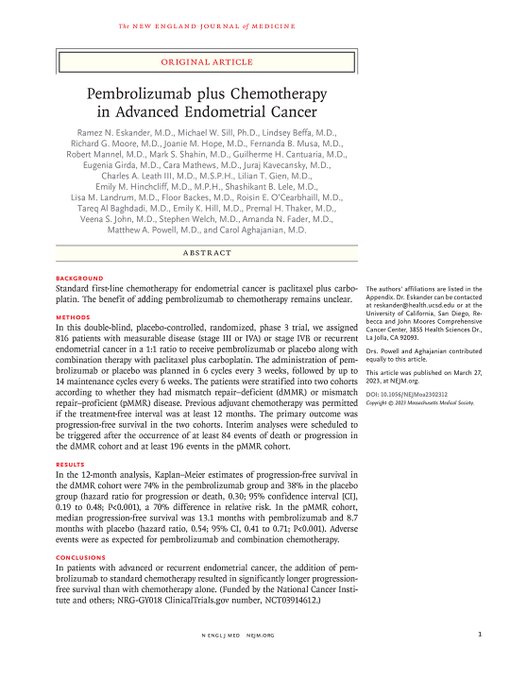
Dr Eskander presented Pembrolizumab versus Placebo in Addition to Carboplatin and Paclitaxel for Measurable Stage 3 or 4a, Stage 4b or recurrent Endometrial Cancer : Phase 3 NRG GYO18 Study (Keynote 868)

Pembrolizumab is an immune checkpoint inhibitor that binds to the protein PD-1.  Endometrial cancer patients who were stage III, IVa , IVB or recurrent endometrial cancer enrolled in the trial. They were given carboplatin / paclitaxel ( Standard of care) with pembrolizumab, a PD1 inhibitor or placebo followed by maintenance with pembrolizumab. Patients were separated into two cohorts according to whether they had mismatch repair–deficient (dMMR) or mismatch repair–proficient (pMMR) disease. The interim efficacy analysis showed in the pMMR cohort, median progression-free survival was 13.1 months with pembrolizumab and 8.7 months with placebo. 

The study was released minutes after the presentation Sunday afternoon in the NEJM.  https://www.nejm.org/doi/full/10.1056/NEJMoa2302312  Additional information may be found here.


Page 1 of "Pembrolizumab plus Chemotherapy in Advanced Endometrial Cancer" by Eskander et al.

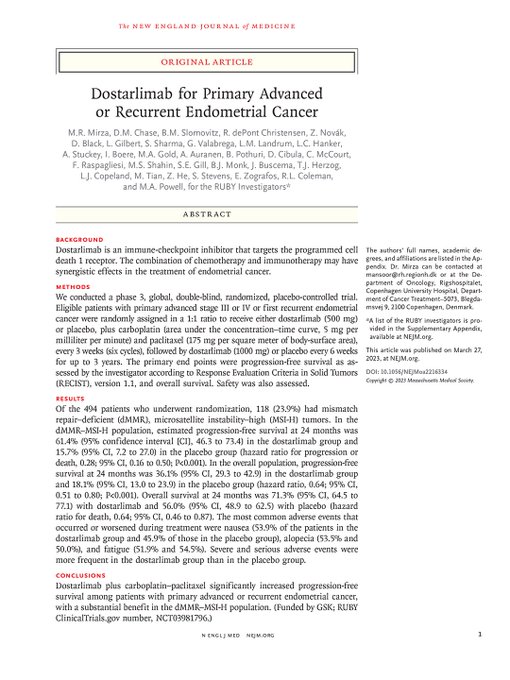
Dr Mirza presented Dostarlimab for Primary Advanced or Recurrent Endometrial Cancer. (Ruby trial)

Dostarlimab, an immune checkpoint inhibitor to anti-programmed cell death receptor-1 (PD-1) was used in this Phase 3 trial. Women  with stage III, IV or recurrent endometrial cancer were give dostarlimab with carboplatin/ paclitaxel and then maintenance dostarlimab every 6 weeks for up to 3 years. In the dMMR–MSI-H ( mismatch repair–deficient, microsatellite instability–high) population, estimated progression-free survival at 24 months was 61.4%  versus 15.7% in the placebo group. Overall survival at 24 months was 71.3% with dostarlimab and 56.0% with placebo.   

This study was also published online in the NEJM shortly after the presentation. nej.md/40lFbBN
Additional information may be read here. 

Page 1 of "Dostarlimab for Primary Advanced or Recurrent Endometrial Cancer" by Mirza et al.

This tweet sums up the two studies

Comments that I heard from various gynecologic oncologists after the session was that these two studies will impact endometrial cancer patient care in the near future.

 More SGO news to come!


Dee

Every day is a blessing!

Tuesday, March 29, 2022

SGO 2022 Annual Meeting Cervical Cancer Studies

As an ovarian cancer survivor, I normally concentrate my posts on ovarian cancer but there were a number of very interesting  cervical cancer and endometrial cancer studies/results presented at the SGO annual meeting. 

This post will focus on the cervical cancer sessions.

Scientific Plenary II: Building Bridges - Pioneering Protocols and Scientific Progress

Patient-Reported Outcomes from the Phase 3 Randomized, Double-Blind, KEYNOTE-826 Trial of Pembrolizumab Plus Chemotherapy Versus Placebo Plus Chemotherapy for the First-Line Treatment of Persistent, Recurrent, or Metastatic Cervical Cancer -  Monk


Safety and Immunogenicity of Anti PD-L1 (Atezolizumab) Given as an Immune Primer or Concurrently with Extended Field Chemoradiotherapy for Node Positive Locally Advanced Cervical Cancer: an NRG Oncology Trial –  J. Mayadev 


Pembrolizumab for Persistent, Recurrent, or Metastatic Cervical Cancer: a Cost-Effectiveness Analysis –  D. Barrington  


Scientific Plenary III: Novel Therapeutics: The Expanding Toolbox
 
Efficacy and Safety of Serplulimab (an anti-PD-1 antibody) Combined with Albumin-Bound Paclitaxel in Patients with Advanced Cervical Cancer who Have Progressive Disease or Intolerable Toxicity After First-Line Standard Chemotherapy – J. An


Efficacy and Safety of Cadonilimab, an Anti-PD-1/CTLA4 Bi-Specific Antibody, in Previously Treated Recurrent or Metastatic (R/M) Cervical Cancer: A Multicenter, Open-Label, Single-Arm, Phase II Trial – Speaker: X. Wu


Open vs. Minimally Invasive Radical Hysterectomy in Early Cervical Cancer: LACC Trial Final Analysis – R. Ramirez I recalled the initial discussion/ debate on minimally invasive hysterectomy vs open surgery at an ASCO meeting a few years ago. Minimal invasive hysterectomy surgery should not be used.


The next post will report on some endometrial cancer  studies

Dee 
Every Day is a Blessing!


Tuesday, March 23, 2021

2021 SGO Virtual Annual Meeting Saturday March 20

Here are highlights from the Virtual #SGOmtg sessions I attended on Saturday March 20, 2021. 

The morning began with a wonderful get-together for Patient Advocates at a 9am session. I am so glad to see patient advocates play a role in so many aspects of the SGO organization.

 In real time, I shared information on Twitter( @womenofteal) about the sessions I attended using the #gyncsm and #SGOmtg hashtags

 Surgery:

MEDSCAPE shared this article on MIS and interval debulking surgery. https://www.medpagetoday.com/meetingcoverage/sgo/91738

Equity 

PAOLA-1 Olaparib plus Bev

Tumor infiltrating lymphocytes

Keynote 158 Cervical Cancer


 ENGOT-OV 16/ NOVA  niraparib

PARP Inhibitor duration of follow-up

Cervical Cancer Radiation study

Shared Decision Making Tool

Niraparib as Maintenance Therapy- Dr Matalunis https://ascopost.com/videos/sgo-2021-virtual-annual-meeting-on-womens-cancer/ursula-matulonis-on-ovarian-cancer-niraparib-as-maintenance-therapy/

Stop by tomorrow for my Sunday highlights.  

Dee

Every Day is a Blessing!

Tuesday, March 19, 2019

SGO Annual Meeting - Sunday/ Monday

Delayed but here are some important tweets from the SGO meeting on Sunday and Monday.


Risk Reducing Salpingectomy and QOL


 Phase 1 Levantinib and weekly taxol in recurrent OC
PARP and ARID1A

JAVELIN  - Avelumab+peg liposomal doxorubicin VS peg liposomal doxorubicin

Phase 2 Pembro and Bev

Minorities and clinical trials

OC Patient Preferences - maintenance therapy

CCNE1 and BRD4 Expression and platinum resistance

 Thank you @KMKoerten , @DKhabeleMD, @ShannonWestin, @Stigetta, @SW_MedReporter, @StephASullivan, @StephanieVBlank for posting from the meeting!


Dee
Every Day is a Blessing! 

Wednesday, March 23, 2016

SGO News via Twitter - March 21-22

I appreciate the use of the #sgomtg hashtag by those advocates, gynecologic oncologists and researchers attending the SGO Annual meeting. It has allowed those of us unable to attend to stay on top of the research that can impact the lives of women with a gynecologic cancer.

This blog will cover tweets from the meeting dates March 21-22, 2016 .
The presentation by Dr Frey will be covered in a separate blog post.

You may find more information on enhanced recovery pathways in this journal article. (Enhanced Recovery in Gyneocologic Surgery http://www.ncbi.nlm.nih.gov/pmc/articles/PMC3913481/ )


CSC= cancer stem cell

Thank you to all the researchers who consider the needs of their patients as they develop better treatments, detection tests and a cure.

Dee
Every Day is a Blessing! 

Tuesday, June 9, 2015

ASCO: Knowledge Part I - Phase 1 Immunotherapy studies

-->
While at the ASCO meeting I viewed a large number of posters  and listened to sessions reporting on the  results of new immunotherapy treatments.  Here are four  in the initial stages of testing that  caught my eye.  

Poster  Board:  #95    First ­in ­human  phase I/II  dose­ escalation  study  of  IMAB027  in  patients  with  recurrent  advanced  ovarian  cancer  (OVAR):  Preliminary  data  of  

phase  I  part. 
Ugur  Sahin,  MD

This study was done in a group of women (median age 64 years) that had been highly pretreated, meaning they had multiple ( 4 +) prior treatments for their disease. This Phase I/II study ( safety and dosage levels)  used IMAB027 is the first-in-class monoclonal antibody (mAB) directed against claudin 6 (CLDN6), a cancer stem cell marker. Claudin-6 is expressed in 55% of ovarian cancers. The 12 women in the study were all claudin 6+. There were some adverse events recorded but the majority were grade 1-2 (the lower the grade the less severe the adverse effect). The first signs of clinical activity were observed. 

“Conclusions: This is the first clinical study to show effects of a therapy targeting CLDN6. Based on these preliminary Phase I data, IMAB027 may present a safe and well tolerated treatment option for women with recurrent, advanced OC. This warrants further clinical evaluation of IMAB027”


Poster  Board:  #116  Phase 1 study of  IMGN853,  a  folate  receptor  alpha  (FRα )targeting  antibody­ drug conjugate (ADC) in  patients (Pts) with epithelial ovarian cancer (EOC)
and other  FRα ­positive  solid  tumors
Hossein  Borghaei,  DO,  MS

This Phase 1 trial included 23 women with platinum resistant epithelial ovarian cancer , 11 women with endometrial cancer as well as 1 cervical, 4 non-small cell lung cancer and 5 renal cancer patients. The study was done to determine safety, pharmacokinetics (PK – how the drug moves through the body), tolerated dose, and evidence of activity of IMGN853 in ovarian cancer or other FRa-positive solid tumors. 
“IMGN853 (mirvetuximab soravtansine) is a folate receptor α-targeting anti-body drug conjugate (ADC ) comprising a FRα-binding antibody and potent maytansinoid, DM4.”  
 In other words,  IMGN853 binds to Folate Receptor α on cancer cells and is internalized; the DM4 ( a tubulin-acting agent) is released through the degradation of the antibody and it disrupts cell division and causes cell death. Two different schedules were used (A) once every 3 weeks and (B) Days 1, 8, and 15, every 4 weeks. The adverse effects were mostly grade 1 or 2.  Initial results show partial and complete clinical response as well as  CA-125 response. In A schedule, 11 of 44 patients showed complete response(CB), 4/44 showed partial response(PR)  and 5 showed stable disease (SD) . Using schedule B,  5/15 showed CR, 1 PR, 4 SD. 

"Conclusion: With both schedules,IMGN853 demonstrates encouraging clinical activity in heavily pretreated patients during dose escalation with a manageable AE profile. A RP2D has been identified for schedule A, while schedule B continues dose finding."


The following results were presented in a session called
Intersection of  Mutanome and the Immunome on Monday afternoon.

Avelumab  (MSB0010718C), an anti­PD­L1 antibody, in  patients  with  previously  treated,  recurrent  or  refractory  ovarian  cancer:  A  phase Ib, open-­label  expansion  trial.                        
Mary  L.  Disis

Slide on Avelumab from Dr Disis' presention

Avelumab  (MSB0010718C) is a human anti-PD-L1 IgG1 antibody.  PD-1 is a programmed death -1 receptor and PD-L1 is it’s ligand ( protein) are targets that can help to reactivate  a person’s immune system.
The patients enrolled in this Phase 1b study were not chosen based on PDL-1 expression. All patients had recurrent ovarian cancer and had multiple prior treatments. 52% of the patients reported adverse effects mostly fatigue, nausea, chills and diarrhea . Of the 23 patients currently enrolled and followed for 2-8 months,  4 patients showed best overall response, 11 had stable disease and 4 had a shrinkage of their tumor of >30%. During the presentation it was reported that patients who had smaller tumor burdens had a better response.

"Conclusions: These data represent the largest reported dataset of patients with recurrent ovarian cancer treated with anti-PD-L1 therapy. Avelumab demonstrated an acceptable safety profile and is clinically active in this heavily pretreated ovarian cancer pt population."


Antitumor activity and safety of pembrolizumab in patients (pts) with  PD-­L1 positive advanced ovarian  cancer: Interim results from a phase Ib study                              
Andrea  Varga,  MD

Slide from Dr Varga's presentation

This was the second of two presentations on anti-PDL-1 immunotherapy treatments that I heard. Pembrolizumab is a monoclonal antibody against PD-1 and blocks the interaction of PD-L1 and PD-L2 . It also removes any blockage by the cancer cells of the body’s T-cells. T-cells are part of your body’s immune response to cancer. This study unlike the previous study with Avelumab was with women who were determined to be PD-l+. They received 10mg/kg of Pembrolizumab every two weeks. Twenty-six patients (median age 56) were enrolled.  Over 80% had prior treatments. There were no grade 4 or 5 adverse effects. Reported effects include fatigue, anemia  and loss of appetite. One patient had complete response, 2 had partial response and 6 had stable disease. 23% of the patients had experienced a decrease in their targeted lesions.

"Conclusions: PD-1 blockade with pembrolizumab is well tolerated and has antitumor activity in pts with advanced ovarian cancer. This preliminary signal for clinical efficacy will be further investigated."

Note:To learn more about pembrolizumab ( Keytruda) , which is approved for melanoma visit https://www.keytruda.com/melanoma/how-keytruda-works/index.xhtml

These handful of studies are just the tip of the iceburg when it comes to targeted immunotherapy treatments for gynecologic cancers. I look forward to hearing the results of future Phase II and III studies.  

In the next post I will write about the session I heard on Managing Ovarian Cancer in the Older Patient.

Dee
Every Day is a Blessing!