Showing posts with label testing. Show all posts

Tuesday, February 4, 2020

ASCO Releases the Germline and Somatic Tumor Testing in Epithelial Ovarian Cancer Guideline

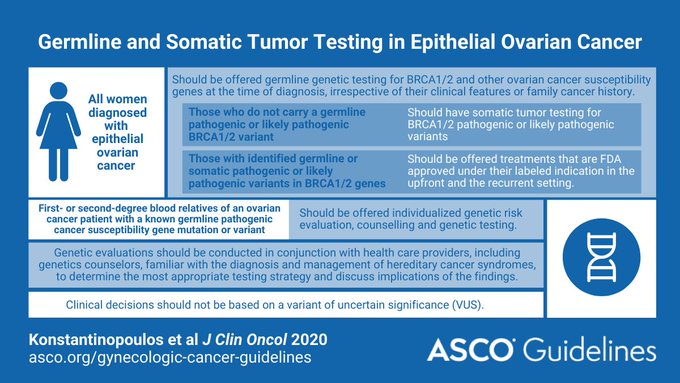
On January 27, 2020, ASCO released the Germline and Somatic Tumor Testing in Epithelial Ovarian Cancer Guideline.  


Image
© 2020 American Society of Clinical Oncology, all rights reserved.


Recommendations from the ASCO website include:

"All women diagnosed with epithelial ovarian cancer should have germline genetic testing for BRCA1/2 and other ovarian cancer susceptibility genes

In women who do not carry a germline pathogenic or likely pathogenic BRCA1/2 variant, somatic tumor testing for BRCA1/2 pathogenic or likely pathogenic variants should be performed. 


Women with identified germline or somatic pathogenic or likely pathogenic variants in BRCA1/2 genes should be offered treatments that are US Food and Drug Administration (FDA) approved in the upfront and the recurrent setting. 

Women diagnosed with clear cell, endometrioid, or mucinous ovarian cancer should be offered somatic tumor testing for mismatch repair deficiency (dMMR). 

Women with identified dMMR should be offered FDA-approved treatment based on these results. 

Genetic evaluations should be conducted in conjunction with health care providers familiar with the diagnosis and management of hereditary cancer. First- or second-degree blood relatives of a patient with ovarian cancer with a known germline pathogenic cancer susceptibility gene variant should be offered individualized genetic risk evaluation, counseling, and genetic testing. 

Clinical decision making should not be made based on a variant of uncertain significance. 

Women with epithelial ovarian cancer should have testing at the time of diagnosis. "

You may read the complete guideline with recommendations and evidence from the 19 studies reviewed for the guideline at https://www.asco.org/research-guidelines/quality-guidelines/guidelines/gynecologic-cancer#/142631 

Dee
Every Day is a Blessing.

Tuesday, July 9, 2019

#CANCERSM Chat topic 11-Jul-2019: Basics of Biomarker Testing

A number of cancer Twitter communities( #gyncsm, #bcsm, #btsm,#lcsm etc) are joining together for a chat on Biomarkers on Thursday, July 11, 2019 I hope some of my followers will join that chat at 8pm ET. pPathologist Dr. Timothy Craig Allen (@TimAllenMDJD) will be moderating the chat.Learn more by reading the post below by Janet Freeeman-Daily.

#CANCERSM Chat topic 11-Jul-2019: Basics of Biomarker Testing
Until just a few years ago, chemotherapy was often the only option for some cancer patients. In just a
few short years, molecular therapies and immunotherapies have become commonplace as treatments
for cancer patients. But determining whether a particular cancer patient is a candidate for these new,
often very expensive, molecular and immunotherapies requires molecular biomarker testing. For manycancer patients and their families, the role of molecular biomarker testing in their diagnosis is a
unfamiliar and confusing. How is testing performed? How is the test result analyzed? What is involvedin getting helpful answers from biomarker testing? Does liquid biopsy have a role?
Pathologists are specialized doctors responsible for answering these questions. They identify any cancercells in the biopsied specimen, and guide the patient’s biomarker testing. Unfortunately, pathologists donot typically speak with patients, so patients and families–and even some doctors–often do not have aclear understanding of the role of molecular biomarker testing in the diagnosis and treatment ofcancers. Learning more about the basics of biomarker testing can help patients and families cut throughthe hype about biomarker testing, understand the patient’s specific disease more thoroughly, and learn what biomarker test results mean to the patient’s cancer treatment.

Please join moderator and pathologist Dr. Timothy Craig Allen (@TimAllenMDJD) at 8 PM Eastern Time
on Thursday, July 11, 2019, for a discussion about the basics of biomarker testing, a subject potentially
affecting all cancer patients and doctors. We will cover the following topics:
• T1: What is a biomarker and how is it identified?
• T2: What is biomarker testing and what is it used for?
• T3: What treatment options can be identified through biomarker testing?
• T4: What biomarker tests should be run for which types of cancers? What is a liquid
biopsy and when is useful?
• T5: Can and should patients pursue biomarker testing for treatment options if their
doctor does not offer it?

Please remember to include #cancersm in ALL your tweets so the other chat participants can see them.
If you need a refresher, read the #LCSM primer on participating in a Twitter chat (the hashtag in your
tweets will be #cancersm, not #LCSM). Note that some tweetchat apps (like tchat.io) will not display
tweets longer than 140 characters. Hope you’ll join us!


Dee
Every Day is a Blessing!