Teal is the awareness color of ovarian cancer. Women of Teal is a play on the words "Man of Steel" used to describe Superman. I have found my fellow ovarian cancer survivors to be the strongest, most helpful women in the world. They are truly Women of Teal!
The Late Breaking Abstracts session at the SGO Annual meeting included two important endometrial cancer studies using immune checkpoint inhibitors.
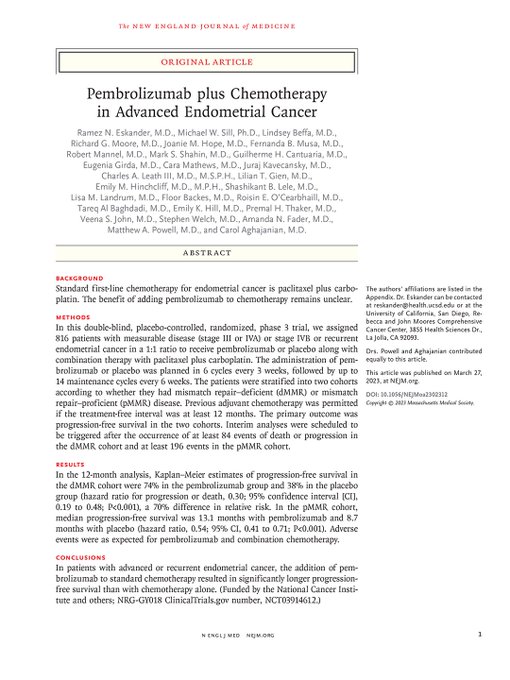
Dr Eskander presented Pembrolizumab versus Placebo in Addition to Carboplatin and Paclitaxel for Measurable Stage 3 or 4a, Stage 4b or recurrent Endometrial Cancer : Phase 3 NRG GYO18 Study (Keynote 868)
Pembrolizumab is an immune checkpoint inhibitor that binds to the protein PD-1. Endometrial cancer patients who were stage III, IVa , IVB or recurrent endometrial cancer enrolled in the trial. They were given carboplatin / paclitaxel ( Standard of care) with pembrolizumab, a PD1 inhibitor or placebo followed by maintenance with pembrolizumab. Patients were separated into two cohorts according to whether they had mismatch repair–deficient (dMMR) or mismatch repair–proficient (pMMR) disease. The interim efficacy analysis showed in the pMMR cohort, median progression-free survival was 13.1 months with pembrolizumab and 8.7 months with placebo.
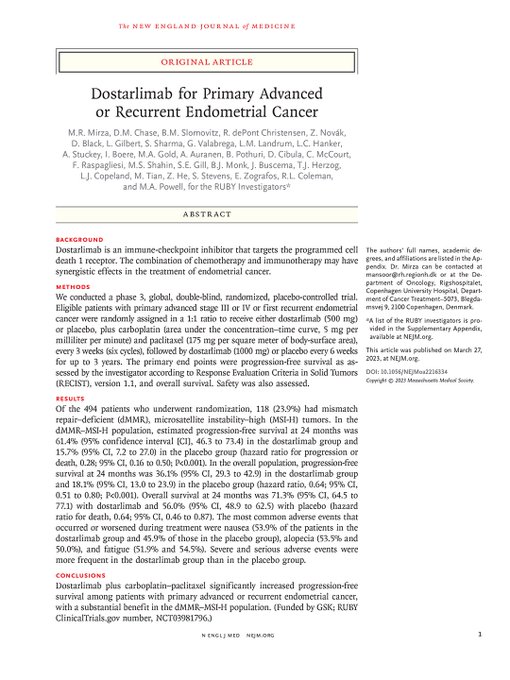
Dr Mirza presented Dostarlimab for Primary Advanced or Recurrent Endometrial Cancer. (Ruby trial)
Dostarlimab, an immune checkpoint inhibitor to anti-programmed cell death receptor-1 (PD-1) was used in this Phase 3 trial. Women with stage III, IV or recurrent endometrial cancer were give dostarlimab with carboplatin/ paclitaxel and then maintenance dostarlimab every 6 weeks for up to 3 years. In the dMMR–MSI-H ( mismatch repair–deficient, microsatellite instability–high) population, estimated progression-free survival at 24 months was 61.4% versus 15.7% in the placebo group. Overall survival at 24 months was 71.3% with dostarlimab and 56.0% with placebo.
This study was also published online in the NEJM shortly after the presentation. nej.md/40lFbBN
Such an amazing leap forward in endometrial cancer. Absolutely revolutionary - and such important and mind-blowing results that will impact and help so many of our patients. &an especially emotional standing ovation for our patients and their families #SGOMtg@SGO_org@rne_mdpic.twitter.com/N5bK0bPZdx
Comments that I heard from various gynecologic oncologists after the session was that these two studies will impact endometrial cancer patient care in the near future.
Over the past few weeks many questions about PARP inhibitor use in the treatment ( front line, recurrent and maintenance) therapies for Ovarian Cancer were asked in many of the private online groups that I participate in. I can understand the questions and confusion because of the different PARPs available for women diagnosed with ovarian cancer - Olaparib ( Lynparza) , Niraparib ( Zejula) and Rucaparib (Rubraca) and their uses.
In this blog post I will describe what a PARP inhibitor is, and provide all the FDA approval information and a few articles that compare the different types.
Let's start with this definition provided by the NCI.
PARP inhibitor
"A substance that blocks an enzyme in cells called PARP. PARP helps
repair DNA when it becomes damaged. DNA damage may be caused by many
things, including exposure to UV light, radiation, certain anticancer
drugs, or other substances in the environment. In cancer treatment,
blocking PARP may help keep cancer cells from repairing their damaged
DNA, causing them to die. PARP inhibitors are a type of targeted
therapy. Also called poly (ADP-ribose) polymerase inhibitor."
I'm more a visual person so here is a video by Dana Farber that you might find helpful.
Now lets look at each PARP and when , who and why it was approved. The FDA pages include references to the clinical trials that the approval was based on. Remember there are still clinical trials enrolling that may use a PARP in combination with other treatments.
Olaparib:Lynparza
2014 FDA Approval Summary: Olaparib Monotherapy in Patients with
Deleterious Germline BRCA-Mutated Advanced Ovarian Cancer Treated with
Three or More Lines of Chemotherapy. https://www.ncbi.nlm.nih.gov/pubmed/26187614
2017
On Aug. 17, 2017, the U.S. Food and Drug Administration granted regular
approval to olaparib tablets (Lynparza, AstraZeneca) for the maintenance
treatment of adult patients with recurrent epithelial ovarian,
fallopian tube, or primary peritoneal cancer, who are in a complete or
partial response to platinum-based chemotherapy.
https://www.fda.gov/drugs/resources-information-approved-drugs/fda-approves-olaparib-tablets-maintenance-treatment-ovarian-cancer
2017
On March 27, 2017 , the U.S. Food and Drug Administration approved
niraparib (ZEJULA, Tesaro, Inc.), a poly ADP-ribose polymerase (PARP)
inhibitor, for the maintenance treatment of adult patients with
recurrent epithelial ovarian, fallopian tube, or primary peritoneal
cancer who are in complete or partial response to platinum-based
chemotherapy. https://www.fda.gov/drugs/resources-information-approved-drugs/niraparib-zejula
2019
On October 23, 2019,the Food and Drug Administration approved niraparib
(ZEJULA, Tesaro, Inc.) for patients with advanced ovarian, fallopian
tube, or primary peritoneal cancer treated with three or more prior
chemotherapy regimens and whose cancer is associated with homologous
recombination deficiency (HRD)-positive status. HRD is defined by either
a deleterious or suspected deleterious BRCA mutation, or
genomic instability in patients with disease progression greater than
six months after response to the last platinum-based chemotherapy. https://www.fda.gov/drugs/resources-information-approved-drugs/fda-approves-niraparib-hrd-positive-advanced-ovarian-cancer
Rucaparib: Rubraca
2016
On December 19, 2016, the U.S. Food and Drug Administration granted
accelerated approval to rucaparib (RUBRACA, Clovis Oncology Inc.) for
treatment of patients with deleterious BRCA mutation (germline and/or
somatic) associated advanced ovarian cancer who have been treated with
two or more chemotherapies.