Wednesday, April 5, 2023

SGO Annual Mtg 2023: Miscellaneous topics

This post completes my coverage of the 2023 SGO Annual Meeting. Below are some tweets on  miscellaneous topics from treatments to testing.

 Cryocompression

Prevention of neuropathy in gyn cancer patients. 

 Immune Biomarkers in Locally Advanced Cervical Cancer 

Combo of durvalumab concurrent with radiation produce more tumor-associated T-cells clones. 

Palliative Care  

Higher value and less aggressive care at end of life with early palliative care.

Palliative care referral was impacted by diagnosis and insurance coverage. 

Breast MRI 

Denials in women with hereditary BRCA1/2 mutations with gyn cancer diagnosis.

Funding gaps  

Significant gaps in funding for gyn cancers compared to other cancer types

Obesity  

Japanese study showed obese women have higher risk of uterine cancer

HPV vaccination

Intervention helps uptake of HPV in clinic 

 Tremelimumab, durvalumab, and radiotherapy

Patients with cervical or vaginal cancers had good overall response rates if high in PDL1

In June I will report on  research of interest presented at the ASCO annual meeting which I will attend virtually. 

Dee

Every Day is a Blessing!

Tuesday, April 4, 2023

SGO Annual Mtg 2023 : Disparities/ Equity Research

In this post I will focus on sharing Tweets and information from the Diversity, Equity presentations I attended at the 2023 SGO Annual Meeting. There were a number of important studies presented to better understand equity issues for those diagnosed with a gynecologic cancer. 

Two studies focused on Asian / Pacific Islanders 

Do we need to separate out non-hispanic Pacific Islanders from Asians? 

Food deserts associated with worse survival outcomes.

 Cervical Cancer 


Clinical Trials - Comorbidity exclusions

Geographic disparities in access to gynecologic oncologists

 Health Literacy 

Low income and racial/ ethnic minorities had lower rates of health literacy which impacts health outcomes  


Additional information may be found at  https://www.healio.com/news/hematology-oncology/20230329/1-in-4-patients-at-gynecologic-oncology-clinic-lack-adequate-cancer-health-literacy


Caring for transgender patients

 Please visit Welcoming Spaces at https://www.sgo.org/welcomingspaces/ for more information. 


Tomorrow's post will highlight some other sessions of interest from palliative care, to compression therapy to  biomarkers to funding.  See you tomorrow!


Dee
Every Day is a Blessing! 

Monday, April 3, 2023

SGO Annual Mtg 2023 Highlights : Ovarian Cancer

I've gathered together some interesting Tweets about ovarian cancer research studies from the SGO 2023 Annual Meeting.

Botensilimab An Fc-engineered recombinant human immunoglobulin (Ig) G1 monoclonal antibody and Balstilimab a PD-1 inhibitor 

Additional information  https://www.cancernetwork.com/view/botensilimab-plus-balstilimab-yields-enduring-responses-in-r-r-ovarian-cancer


SOLAR Trial olaparib (Lynparza) with selumetinib (Koselugo) in patients with RAS-mutant gynecologic malignancies

Find additional information at https://www.onclive.com/view/dr-westin-on-outcomes-of-the-solar-trial-in-ras-mutant-gynecological-malignances


SOLO 1 trial results - 7 year overall survival reported

Additional information may be found at https://www.onclive.com/view/dr-mathews-on-maintenance-olaparib-in-ovarian-cancer


NOVA trial Recurrent ovarian cancer - Niraparib (Zejula) did not produce a statistically significant overall survival (OS) benefit compared with placebo.  


Minimally invasive surgery vs open surgery


Neoadjuvant olaparib - improved surgical outcomes 

 For additional information see https://www.onclive.com/view/neoadjuvant-olaparib-proves-feasible-aids-optimal-resection-in-brca-mutant-ovarian-cancer

mirvetuximab soravtansine-gynx (Elahere)

Steroid eye drops followed by lubricating eye drops and regular visits to an ophthalmologist should be scheduled . For more information see https://www.onclive.com/view/dr-matulonis-on-the-management-of-mirvetuximab-soravtansine-related-toxicities-in-fr-ovarian-cancer

venous thromboembolism (VTE)


For additional information see https://www.medpagetoday.com/meetingcoverage/sgo/103793

If you would like to share additional ovarian cancer studies presented at SGO 2023 please mention in the comment section below. Thanks.

Stop by tomorrow to read Tweets that highlighted studies on equity, diversity at the meeting.


Dee
Every Day is a Blessing! 


Sunday, April 2, 2023

SGO Annual Mtg 2023 Highlights: Endometrial Cancer

The Late Breaking Abstracts session at the SGO Annual meeting included two important endometrial cancer studies using immune checkpoint inhibitors.

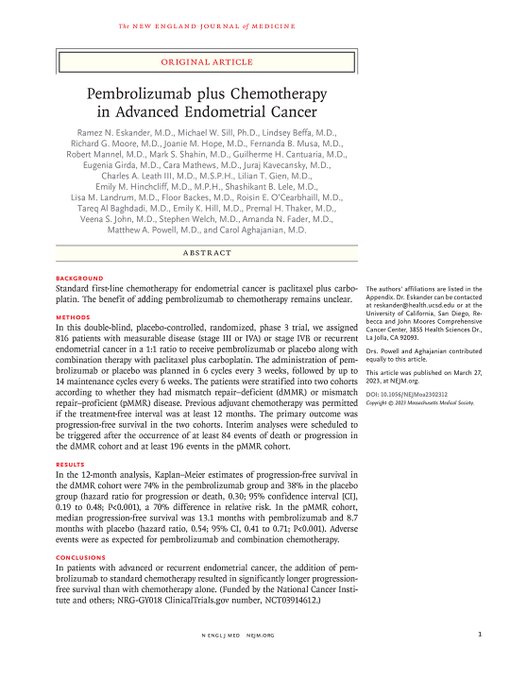
Dr Eskander presented Pembrolizumab versus Placebo in Addition to Carboplatin and Paclitaxel for Measurable Stage 3 or 4a, Stage 4b or recurrent Endometrial Cancer : Phase 3 NRG GYO18 Study (Keynote 868)

Pembrolizumab is an immune checkpoint inhibitor that binds to the protein PD-1.  Endometrial cancer patients who were stage III, IVa , IVB or recurrent endometrial cancer enrolled in the trial. They were given carboplatin / paclitaxel ( Standard of care) with pembrolizumab, a PD1 inhibitor or placebo followed by maintenance with pembrolizumab. Patients were separated into two cohorts according to whether they had mismatch repair–deficient (dMMR) or mismatch repair–proficient (pMMR) disease. The interim efficacy analysis showed in the pMMR cohort, median progression-free survival was 13.1 months with pembrolizumab and 8.7 months with placebo. 

The study was released minutes after the presentation Sunday afternoon in the NEJM.  https://www.nejm.org/doi/full/10.1056/NEJMoa2302312  Additional information may be found here.


Page 1 of "Pembrolizumab plus Chemotherapy in Advanced Endometrial Cancer" by Eskander et al.

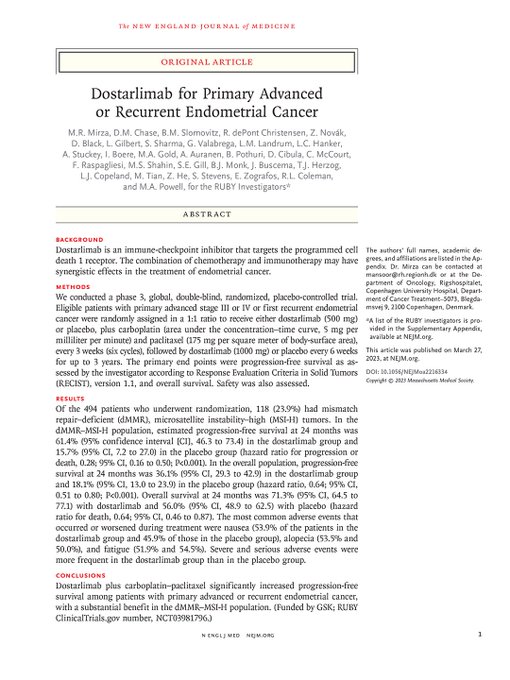
Dr Mirza presented Dostarlimab for Primary Advanced or Recurrent Endometrial Cancer. (Ruby trial)

Dostarlimab, an immune checkpoint inhibitor to anti-programmed cell death receptor-1 (PD-1) was used in this Phase 3 trial. Women  with stage III, IV or recurrent endometrial cancer were give dostarlimab with carboplatin/ paclitaxel and then maintenance dostarlimab every 6 weeks for up to 3 years. In the dMMR–MSI-H ( mismatch repair–deficient, microsatellite instability–high) population, estimated progression-free survival at 24 months was 61.4%  versus 15.7% in the placebo group. Overall survival at 24 months was 71.3% with dostarlimab and 56.0% with placebo.   

This study was also published online in the NEJM shortly after the presentation. nej.md/40lFbBN
Additional information may be read here

Page 1 of "Dostarlimab for Primary Advanced or Recurrent Endometrial Cancer" by Mirza et al.

This tweet sums up the two studies

Comments that I heard from various gynecologic oncologists after the session was that these two studies will impact endometrial cancer patient care in the near future.

 More SGO news to come!


Dee

Every day is a blessing!

Thursday, March 30, 2023

SGO Annual Mtg 2023 Highlights - Participation

I returned recently from an exciting and informative SGO Annual Meeting. Over the next few days I will highlight research results that I found most impactful to patients, survivors and caregivers.  This blog post will be on participation and will cover how other advocates and I  participated in the meeting. 

The Foundation for Women's Cancer held a Patient Education Forum on Friday. They presented information on ovarian, endometrial, cervical rare gynecologic cancers as well as information on exercise, advocacy  and other topics. Some survivors shared the story of diagnosis and treatment. The room was filled with survivors, caregivers and advocates as well as organizations that support women with gyn cancers. 

Later that evening advocates were invited to the Foundation for Women's Cancer reception. Advocates were able to meet each other as well as gyn oncs, researchers and leadership of the Foundation. 

Saturday was a busy day. As a member of the SGO Communication Committee, I had the opportunity to participate in the  Education Forum Media Readiness session. I was part of a role play session on how to use different techniques such as pivot, personalize, deflect,acknowledge, and broaden when being interviewed by the media. As an advocate I am asked to comment on new treatments or breaking news and the tips shared during the session were helpful to me.


During the very next session Annie Ellis, survivor and advocate, presented Long-term survivors speak: perspectives on progress, during a Scientific Plenary Session. Annie and I  held a roundtable Zoom meeting and also surveyed long term ovarian cancer survivors about progress,  patient needs, and what ovarian cancer survivors want their doctor to know. It was so exciting to see Annie present and to hear the applause and comments that followed!


If you have questions about our abstract, don't hesitate to reach out to me for further details. 

On Sunday, the  Patient Education Committee held a advocate poster walk in which advocates were able view posters and to listen and ask questions of the poster authors. We were also given the opportunity to vote for the  Patient Advocate Hope Award winner. It was wonderful to see so many early career clinicians and researchers present their research. 


 I'll continue my highlight blog posts over the next few days.


Dee
Every Day is a Blessing

Sunday, March 19, 2023

SGO Meeting Preparations


Thanks to support from my Cancer Center, I am heading south to Tampa for the SGO Annual Meeting on Friday. The theme of the meeting is Patients | Purpose | Progress. I'm so excited to be meet up with other survivors/advocates and to learn from the researchers who are making advances to improve the care of patients diagnosed with a gynecologic cancer. 

When I arrive on Friday, barring any airline delays, I hope to attend at least part of the Patients and Advocates Education Forum and Luncheon. I have attended them in the past and have always found them beneficial. This is the first once to be held in person since Covid began. 

Saturday, March 25th, will be an especially busy day for me. 

As a member of the SGO Communications Committee I will be part of a presentation on Saturday ( 2:45pm Ballroom A) . This Education Forum, Ready for Primetime: Media Readiness will present strategies of how to best respond and state your position when asked questions by the media.  

Following the Forum, the Scientific Plenary II session (East Hall, 4pm) will take place.  Survivor/advocate, Annie Ellis, will be presenting Long-term survivors speak: patient perspectives on progress, an abstract she and I co-authored. I will share more about the abstract after the meeting.

There are a number of other sessions I am looking forward to attending and am busy working on the app to set up my schedule and work in some time to meet up with some of my gyn onc friends. 

On Twitter,  be sure to follow the hashtags #SGOmtg and #gyncsm for news from the meeting. 

I'll be posting highlights here once the meeting concludes.

Dee
Every Day is a Blessing! 


Sunday, March 5, 2023

Managing the Risk of Ovarian Cancer - OCRA

I've been meaning to write about OCRA's latest consensus statement. So I am happy to share this information/ text from the Ovarian Cancer Research Alliance.


Ovarian Cancer Research Alliance (OCRA), with the full endorsement of the Society of Gynecologic Oncology, has launched a new campaign in the fight against ovarian cancer, a bold and important direction for everyone who cares about the future of this field and who cares about saving lives.

The campaign, called Until There’s a Cure, urges people to know their risk; promotes genetic testing to at-risk populations; and encourages women and anyone born with ovaries to discuss prophylactic surgery with their doctor.

“There is currently no cure for the deadliest of all gynecological cancers, nor is there a way to screen for it that has any impact on mortality. But we know there is a way to dramatically reduce the risk,” said Audra Moran, President and CEO of OCRA. “Ovarian cancer is considered a rare disease, but for those with a family history and/or genetic mutation, the risk jumps to 40-50% or even higher. So, knowing one’s risk level is critical. We also know that 70% of ovarian cancer begins in the fallopian tubes, so we are encouraging people who are done having children to discuss with their doctors the possibility of having their tubes removed. Essentially, we want everyone with ovaries to know their risk level, and to know the actions they can take to help prevent ovarian cancer. Until there is a cure, these are our best weapons in this battle.”

Because knowing one’s risk level is critical, OCRA is providing free at-home genetic testing kits to anyone with a personal or family history of breast, gynecologic, or colon cancer. These individuals can fill out a brief questionnaire to determine whether they qualify for the program, and, if they do, have the kits sent to them at no cost. (The test kits are being offered to people 18 or older in the United States only.)

Concurrently, OCRA urges women and those born with ovaries to discuss preventative action with their doctor. Scientists know that the most common and lethal form of ovarian cancer actually starts in the fallopian tubes, with microscopic precursor lesions developing long before any symptoms would ever arise. People who are at increased risk for developing ovarian cancer should consider bilateral salpingo-oophorectomy (removal of both fallopian tubes and ovaries) or bilateral salpingectomy (removal of the fallopian tubes, but keeping the ovaries in place so as to avoid surgical menopause). Those at average risk for developing ovarian cancer and who are undergoing pelvic surgeries for benign conditions (hysterectomy, tubal ligation, cysts, endometriosis) should consider having their tubes removed at the same time (a procedure known as opportunistic salpingectomy).

“Opportunistic salpingectomy is not targeted toward specific patients. It is not meant for high-risk patients,” said OCRA’s Scientific Advisory Committee member Dr. Celeste Leigh Pearce at University of Michigan, who co-authored a recent study on the subject. “We are targeting the 80% of high-grade serous cancers that arise in people with no genetically increased risk for ovarian cancer and trying to reduce the incidence of ovarian cancer overall by providing this safe and seemingly effective procedure at the time of hysterectomy or instead of tubal ligation.”

The new, aggressive strategy replaces decades of a focus on symptom awareness and early detection, after a rigorous clinical trial in the United Kingdom that followed more than 200,000 women for more than 20 years revealed sobering and deeply disappointing news: that current screening methods do not impact mortality in average-risk women. Put more simply, the trial showed screening and symptom awareness will not save lives.

“This is incredibly hard information to accept and runs contrary to almost all messaging related to ovarian cancer awareness to date. However, to ignore learnings gained from current research would be detrimental to the wellbeing of women and the future of ovarian cancer research,” said Moran. “We have to focus our limited resources on what we know actually works.”

Learn more about the campaign and how to receive free, at-home genetic testing.

 Dee

Every Day is a Blessing!