Showing posts with label genetic testing. Show all posts

Sunday, March 5, 2023

Managing the Risk of Ovarian Cancer - OCRA

I've been meaning to write about OCRA's latest consensus statement. So I am happy to share this information/ text from the Ovarian Cancer Research Alliance.


Ovarian Cancer Research Alliance (OCRA), with the full endorsement of the Society of Gynecologic Oncology, has launched a new campaign in the fight against ovarian cancer, a bold and important direction for everyone who cares about the future of this field and who cares about saving lives.

The campaign, called Until There’s a Cure, urges people to know their risk; promotes genetic testing to at-risk populations; and encourages women and anyone born with ovaries to discuss prophylactic surgery with their doctor.

“There is currently no cure for the deadliest of all gynecological cancers, nor is there a way to screen for it that has any impact on mortality. But we know there is a way to dramatically reduce the risk,” said Audra Moran, President and CEO of OCRA. “Ovarian cancer is considered a rare disease, but for those with a family history and/or genetic mutation, the risk jumps to 40-50% or even higher. So, knowing one’s risk level is critical. We also know that 70% of ovarian cancer begins in the fallopian tubes, so we are encouraging people who are done having children to discuss with their doctors the possibility of having their tubes removed. Essentially, we want everyone with ovaries to know their risk level, and to know the actions they can take to help prevent ovarian cancer. Until there is a cure, these are our best weapons in this battle.”

Because knowing one’s risk level is critical, OCRA is providing free at-home genetic testing kits to anyone with a personal or family history of breast, gynecologic, or colon cancer. These individuals can fill out a brief questionnaire to determine whether they qualify for the program, and, if they do, have the kits sent to them at no cost. (The test kits are being offered to people 18 or older in the United States only.)

Concurrently, OCRA urges women and those born with ovaries to discuss preventative action with their doctor. Scientists know that the most common and lethal form of ovarian cancer actually starts in the fallopian tubes, with microscopic precursor lesions developing long before any symptoms would ever arise. People who are at increased risk for developing ovarian cancer should consider bilateral salpingo-oophorectomy (removal of both fallopian tubes and ovaries) or bilateral salpingectomy (removal of the fallopian tubes, but keeping the ovaries in place so as to avoid surgical menopause). Those at average risk for developing ovarian cancer and who are undergoing pelvic surgeries for benign conditions (hysterectomy, tubal ligation, cysts, endometriosis) should consider having their tubes removed at the same time (a procedure known as opportunistic salpingectomy).

“Opportunistic salpingectomy is not targeted toward specific patients. It is not meant for high-risk patients,” said OCRA’s Scientific Advisory Committee member Dr. Celeste Leigh Pearce at University of Michigan, who co-authored a recent study on the subject. “We are targeting the 80% of high-grade serous cancers that arise in people with no genetically increased risk for ovarian cancer and trying to reduce the incidence of ovarian cancer overall by providing this safe and seemingly effective procedure at the time of hysterectomy or instead of tubal ligation.”

The new, aggressive strategy replaces decades of a focus on symptom awareness and early detection, after a rigorous clinical trial in the United Kingdom that followed more than 200,000 women for more than 20 years revealed sobering and deeply disappointing news: that current screening methods do not impact mortality in average-risk women. Put more simply, the trial showed screening and symptom awareness will not save lives.

“This is incredibly hard information to accept and runs contrary to almost all messaging related to ovarian cancer awareness to date. However, to ignore learnings gained from current research would be detrimental to the wellbeing of women and the future of ovarian cancer research,” said Moran. “We have to focus our limited resources on what we know actually works.”

Learn more about the campaign and how to receive free, at-home genetic testing.

 Dee

Every Day is a Blessing!

Tuesday, February 4, 2020

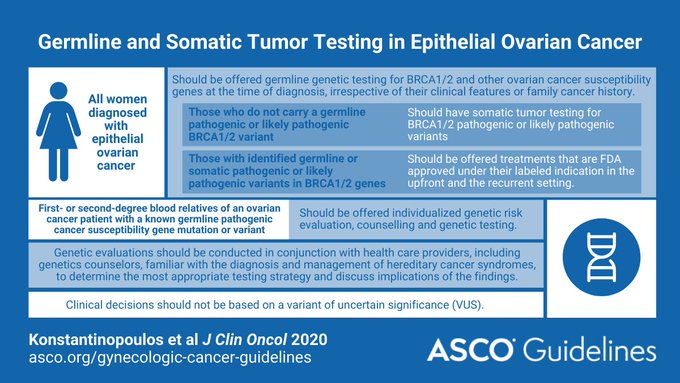
ASCO Releases the Germline and Somatic Tumor Testing in Epithelial Ovarian Cancer Guideline

On January 27, 2020, ASCO released the Germline and Somatic Tumor Testing in Epithelial Ovarian Cancer Guideline.  


Image
© 2020 American Society of Clinical Oncology, all rights reserved.


Recommendations from the ASCO website include:

"All women diagnosed with epithelial ovarian cancer should have germline genetic testing for BRCA1/2 and other ovarian cancer susceptibility genes

In women who do not carry a germline pathogenic or likely pathogenic BRCA1/2 variant, somatic tumor testing for BRCA1/2 pathogenic or likely pathogenic variants should be performed. 


Women with identified germline or somatic pathogenic or likely pathogenic variants in BRCA1/2 genes should be offered treatments that are US Food and Drug Administration (FDA) approved in the upfront and the recurrent setting. 

Women diagnosed with clear cell, endometrioid, or mucinous ovarian cancer should be offered somatic tumor testing for mismatch repair deficiency (dMMR). 

Women with identified dMMR should be offered FDA-approved treatment based on these results. 

Genetic evaluations should be conducted in conjunction with health care providers familiar with the diagnosis and management of hereditary cancer. First- or second-degree blood relatives of a patient with ovarian cancer with a known germline pathogenic cancer susceptibility gene variant should be offered individualized genetic risk evaluation, counseling, and genetic testing. 

Clinical decision making should not be made based on a variant of uncertain significance. 

Women with epithelial ovarian cancer should have testing at the time of diagnosis. "

You may read the complete guideline with recommendations and evidence from the 19 studies reviewed for the guideline at https://www.asco.org/research-guidelines/quality-guidelines/guidelines/gynecologic-cancer#/142631 

Dee
Every Day is a Blessing.

Saturday, May 4, 2019

Comment Period -Germline and Somatic Tumor Testing in Epithelial Ovarian Cancer guideline

ASCO develops practice guidelines for cancer treatment and care. Currently draft recommendations for the Guideline for Germline and Somatic Tumor Testing in Epithelial Ovarian Cancer  is open for comment. The public is invited to comment on the draft.

Here is information from ASCO  if you would like to read and comment on the draft rerecommendations -

ASCO invites interested stakeholders to submit comments on draft recommendations from the Germline and Somatic Tumor Testing in Epithelial Ovarian Cancer: ASCO Clinical Practice Guideline. 
To participate, interested reviewers can download the confidentiality agreement and email a signed copy to guidelines@asco.org to receive access to the survey containing the guideline recommendations. Comments will be accepted through Thursday, May 16. Learn more at www.asco.org/open-comment-guidelines.
 
Advocates, patients and caregivers may comment too.

Dee
Every Day is a Blessing!

Sunday, August 19, 2018

Medically Underserved Individuals and BRCA Testing Study Results - JAMA article

Knowledge of whether or not you have a hereditary BRCA 1 or 2 mutation can impact the treatment decisions of women diagnosed with breast and ovarian cancer.

Last week, researchers reported the results of an analysis of the Southern Community Cohort Study (JAMA). From 2002-2009 over 49,000 women were recruited to the Southern Community Cohort Study from community health centers in twelve southeastern states. Of those women 2002 had breast, ovarian or both cancers. Of that group 718 (62% black and 33% white; 689 breast cancer and 30 ovarian cancer) were covered by medicare. Sixty-two percent of the women reported an annual income of less than $15,000. Ninety-two of the 718 women would qualify to have Medicare cover the cost of BRCA testing.

Amy Gross, PhD Vanderbilt University reported that of those 92 women only 8 had BRCA testing within five years of diagnosis.  Analysis of the medical records from the twelve states showed that Arkansas, Louisiana, Tennessee, and West Virginia had zero tests.  When data from 2000-2004 was examined it was found that no eligible women were given a BRCA test. Later years showed an increase in testing but in 2010-2014 only ~ 15% received the test. “This testing rate is lower than what I have seen reported in terms of any other study with the same time and eligibility constraints,” Gross said.(VUMC Reporter) The numbers did improve over time

While the sample size is small there could be a few reasons for why the numbers are so low including lack of interest on the part of the patient, lack of referrals for testing by physicians or lack of available resources. The researchers concluded that "novel strategies are needed to ensure that medically underserved women with cancer receive appropriate referral and access to genetic testing."

After reading this report I wonder...
How these numbers from medically underserved individuals compares to women covered by other insurance plans and/or those treated at larger cancer centers during the same time period?

We know that BRCA status is critical in deciding which treatments a women with ovarian cancer provide the most benefit but it also impacts the ability of family members to reduce their risk of breast and ovarian cancer. What can we do to insure that all women diagnosed with epithelial ovarian cancer have access to BRCA genetic testing as recommended by the SGO.

Dee
Every Day is a blessing! 

Tuesday, June 5, 2018

#ASCO18 Twitter Highlights June 4, 2018

Many gyn cancer research topics as well as survivorship issue  were covered on Monday at the ASCO Annual Meeting.

If you were at the meeting and think I missed any important developments please share a link to it in my comments section below.

Genetics / Genetics Counseling


Risk Reducing Surgery


CA-125


Endometriosis and Cannibis Treatment
Mindfulness

Neuropathy


Patient Reported Outcomes- Pain
Enodmetrial Cancer- Posters

Ovarian Cancer - Posters

Fertility Preservation

Metformin in Cancer Treatment

HIPEC

Palliative Care

Recurrent Ovarian Cancer

Neoadjuvant Chemotherapy - OC

 Further details may be found at 

Cediranib and Olaparib for recurrent OC
Further info may be found at


Thank you to all the researchers , advocates, and cancer centers who tweeted from this year's Annual Meeting.

Dee
Every Day is a Blessing!


-->

Monday, June 4, 2018

#ASCO18 Twitter Highlights June 3, 2018

What do you do on a windy, cloudy, raining Sunday in NJ?
Follow tweets from the ASCO of course.

My Twitter news stream was filled with comments on these two non-gyn cancer studies.

Breast Cancer -
The Adjuvant Chemo and 21 Gene Expression Assay study reported at ASCO by Dr J Sparano may be found in this NJEM article https://www.nejm.org/doi/10.1056/NEJMoa1804710.
"Investigators “found that gene tests on tumor samples were able to identify women who could safely skip chemotherapy and take only a drug that blocks the hormone estrogen or stops the body from making it.” From the ASCO Cancer in the News e-mail  .

Lung Cancer - Keytruda Study (Pembroluzimab)
Keytruda "boosts the immune system outperforms chemotherapy in fighting advanced lung cancer, a new trial shows. Keytruda (pembrolizumab) extended life four to eight months longer than chemotherapy in lung cancer patients whose immune systems had been duped by their cancer cells.
"This trial shows that pembrolizumab used alone improves survival as opposed to chemotherapy," said lead researcher Dr. Gilberto Lopes, a medical oncologist with the Sylvester Comprehensive Cancer Center at the University of Miami Health System." From HealthDay / ASCO Cancer in the News e-mail.
https://consumer.healthday.com/cancer-information-5/lung-cancer-news-100/cancer-drug-keytruda-a-new-weapon-against-advanced-lung-tumors-734492.html


Now on to the gyn Tweets/ Studies.
OVARIAN CANCER :

Keynote - niraparib and pembrolizumab
(Median duration response rate of 9.3 months)
 

Vaccine Trial


Genetic Testing

HPV / Cervical Cancer

Immune environment
Trial Design


 Communication

Cancer Prevention

Will check into the #gyncsm and #ASCO18 tweet streams a few times today to catch more news from the meeting. If you are there feel free to use those hashtags or tag me @womenofteal in your posts.

Dee
Every Day is a Blessing!

Monday, June 5, 2017

#ASCO17 Twitter Highlights

I was not able to attend this year's ASCO Annual Meeting in Chicago so instead I followed the latest oncology news from the meeting via Twitter (#ASCO17).  I appreciate all the attendees who used the #gyncsm hashtag too.

Below find the tweets I found most interesting in the areas of gynecologic cancers, social media and survivorship.

Let's start first with how to read cancer related news:
Patient Reported Outcomes Leads to Improved survival
Impact of HPV vaccinations:

PD-1 Pathways in Gynecologic Cancers: 


Progress in High Grade Serous Ovarian Cancer:

Liquid Biopsy

Parp Inhibitors in Ovarian Cancer:

Resection of Recurrent OC:

ICON6:
"ICON6 is designed to evaluate the safety and efficacy of platinum-based chemotherapy in combination with cediranib in women with platinum-sensitive relapsed ovarian cancer . Cediranib is an oral targeted small molecule inhibitor of a key signalling molecule Vascular Endothelial Growth Factor (VEGF) which is an oral inhibitor of tyrosine kinase (TK) activity and acts through blockade of the TK receptor. Cediranib (AZD2171)" source :http://www.icon6.org/


OC risk reduction w/ BRCA mutation:


BRCA testing - ovarian cancer:


Endometrial Cancer and Genetic Testing:
Homologous Recombination Deficiency:

Germline Testing:

Abstract 1524 http://abstracts.asco.org/199/AbstView_199_187114.html

from this study https://www.ncbi.nlm.nih.gov/pmc/articles/PMC3048908/

Immunotherapy:

Screening for OC:


Fallopian Tube /Ovarian Cancer:

Based on this study: https://www.ncbi.nlm.nih.gov/pmc/articles/PMC3048908/

Social Media:

session description- https://iplanner.asco.org/am2017/#/session/12030
 
Li-Fraumeni Syndrome:

Cost of Care:


I hope I'll get the opportunity to report live from ASCO 2018.

Dee
Every Day is a Blessing!

Monday, March 13, 2017

SGO Meeting Highlights via Twitter ~ Day Two, March 13, 2017

More news from the The Society of Gynecologic Oncology (@SGO_org) Annual Meeting. I am at home and have been following Tweets from the meeting using the hashtag #SGOmtg.

Here are some tweets I found of interest today-  Monday, March 13th.

Endometrial Cancer:


Burnout in Gynecologic  Oncologists


Patient Centered Assessment Tool - Great work done by my friend and fellow advocate Annie Ellis.


IP Chemotherapy


Circulating DNA

 Niraparib
 Rucaparib

Genetic Testing

 GPI -  Glucose-6-phosphate isomerase

Neoadjuvant Chemotherapy


Slides from a Sunday presentation on  PARP

Thanks for all those tweeting from the meeting especially these folks

Looking forward to Tweets from tomorrow's meeting.

Dee Every Day is a Blessing!

Monday, March 21, 2016

SGO News via Twitter - March 19-20

Since I was unable to go to San Diego for this year's annual  SGO ( Society of Gynecologic Oncologists) meeting, I've been following the meeting's hashtag #sgomtg on Twitter instead.
Here are the tweets I favorited for the March 19-20th. 
ctDNA - Circulating DNA(https://www.genome.gov/27556716)


SNP = single-nucleotide polymorphism ("most common sequence variation in the human genome is the stable substitution of a single base" (http://www.ncbi.nlm.nih.gov/pmc/articles/PMC2410167/)

I appreciate the ability to have interactions with the gyn oncs and other advocates attending the meeting.

Check back on Wednesday for the tweets I found most interesting for the last two days of the meeting.

Dee
Every Day is a Blessing!

Monday, April 14, 2014

Of SGO and AACR

SGO

The Society of Gynecologic Oncologist held its annual meeting in Tampa in March. There were a number of studies whose results were presented that are of interest to ovarian cancer patients. The SGO also issued a clinical practice statement recommending genetic testing for all women diagnosed with ovarian cancer and endometrial cancers. The #gyncsm(gyn cancer social media)  chat ( of which I am co-moderator) discussed SGO News during their April 9th Chat. To see the topic questions, read the transcript of the chat or refer to the resources presented during the chat,  please see their blog page. If you want to read through the abstracts from the meeting please visit https://www.sgo.org/wp-content/uploads/2014/03/ABSUPP_3.14.14.pdf

This Foundation for Women's Cancer video shares news from the meeting.


The American Association for Cancer Research  held their annual meeting early this month in California. While this annual meeting presented research for all cancers there were a number of interesting studies related to ovarian cancer. ( Search abstracts here.) A prospective study of of over 14,000 women in the Child Health and Development study found an association between irregular menstrual periods and the diagnosis of serous ovarian cancer . In  Irregular Menstruation May Predict Increased Risk of Death From Ovarian Cancer.  published online by AACR, 

“It is notable that the 2.4-fold increase in risk of ovarian cancer death we observed for women with irregular/infrequent cycles in this study is close to the threefold increase in risk observed for women with a family history of ovarian cancer in a first-degree relative,” explained Cohn. “Our study finding could lead to better understanding of the 90 percent of ovarian cancers that occur in women with no family history of ovarian cancer and with no known high-risk inherited mutations.”

The results were independent of race, age or weight. I know that my menstruation was very irregular when I was young and again about 5 years prior to my diagnosis. 

It may be too soon but I wonder if irregular menses needs to be added to our discussion of symptoms of ovarian cancer.   

Dee
Every Day is a Blessing!