Showing posts with label Immune Checkpoint inhibitors. Show all posts

Sunday, April 2, 2023

SGO Annual Mtg 2023 Highlights: Endometrial Cancer

The Late Breaking Abstracts session at the SGO Annual meeting included two important endometrial cancer studies using immune checkpoint inhibitors.

Dr Eskander presented Pembrolizumab versus Placebo in Addition to Carboplatin and Paclitaxel for Measurable Stage 3 or 4a, Stage 4b or recurrent Endometrial Cancer : Phase 3 NRG GYO18 Study (Keynote 868)

Pembrolizumab is an immune checkpoint inhibitor that binds to the protein PD-1.  Endometrial cancer patients who were stage III, IVa , IVB or recurrent endometrial cancer enrolled in the trial. They were given carboplatin / paclitaxel ( Standard of care) with pembrolizumab, a PD1 inhibitor or placebo followed by maintenance with pembrolizumab. Patients were separated into two cohorts according to whether they had mismatch repair–deficient (dMMR) or mismatch repair–proficient (pMMR) disease. The interim efficacy analysis showed in the pMMR cohort, median progression-free survival was 13.1 months with pembrolizumab and 8.7 months with placebo. 

The study was released minutes after the presentation Sunday afternoon in the NEJM.  https://www.nejm.org/doi/full/10.1056/NEJMoa2302312  Additional information may be found here.
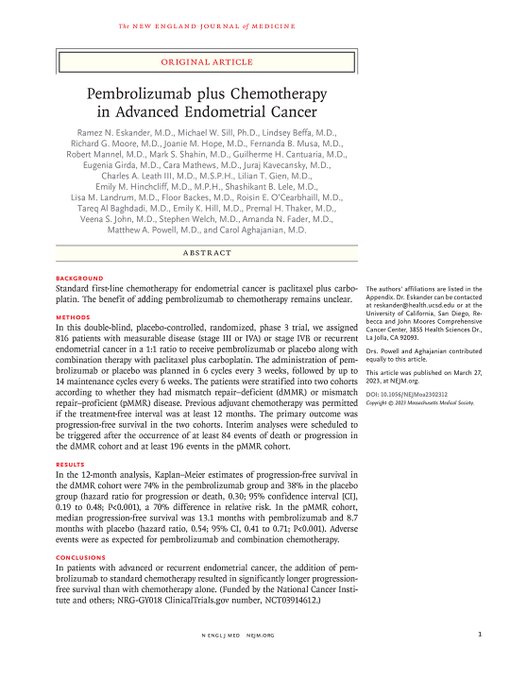

Page 1 of "Pembrolizumab plus Chemotherapy in Advanced Endometrial Cancer" by Eskander et al.

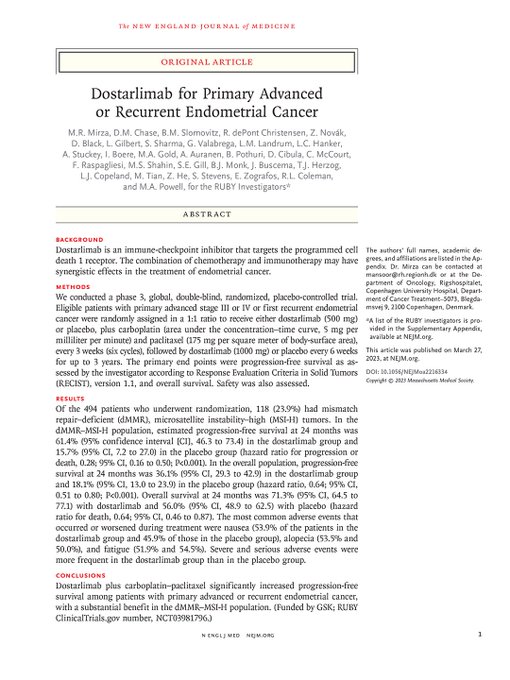
Dr Mirza presented Dostarlimab for Primary Advanced or Recurrent Endometrial Cancer. (Ruby trial)

Dostarlimab, an immune checkpoint inhibitor to anti-programmed cell death receptor-1 (PD-1) was used in this Phase 3 trial. Women  with stage III, IV or recurrent endometrial cancer were give dostarlimab with carboplatin/ paclitaxel and then maintenance dostarlimab every 6 weeks for up to 3 years. In the dMMR–MSI-H ( mismatch repair–deficient, microsatellite instability–high) population, estimated progression-free survival at 24 months was 61.4%  versus 15.7% in the placebo group. Overall survival at 24 months was 71.3% with dostarlimab and 56.0% with placebo.   
This study was also published online in the NEJM shortly after the presentation. nej.md/40lFbBN
Additional information may be read here

Page 1 of "Dostarlimab for Primary Advanced or Recurrent Endometrial Cancer" by Mirza et al.

This tweet sums up the two studies

Comments that I heard from various gynecologic oncologists after the session was that these two studies will impact endometrial cancer patient care in the near future.

 More SGO news to come!


Dee

Every day is a blessing!

Wednesday, January 30, 2019

Research News - Jan 2019

A friend, social media guru and breast cancer survivor, Marie Ennis-O'Connor,  writes a weekly post in which she shares blog posts she found interesting from the week before.  In 15 Smart Ways to Drive More Traffic To Your Blog in Medium ( https://medium.com/@JBBC/15-effective-ways-to-drive-more-traffic-to-your-blog-75e1943b88f4) to recommended creating "a weekly round-up post on your blog".  I've been meaning to do this for a while but had trouble deciding what I wanted to share. Should it be journal articles or survivor stories or new resources or events? Earlier this week I decided to concentrate on research news and went to work creating a graphic I could use for these repeating posts.


On the last Wednesday of the month I will provide links to articles on ovarian cancer research and treatments I read during that month.

Here are some interesting articles published in January:

"The recent addition of targeted therapies – anti-angiogenic agents and PARP inhibitors – to the pharmacologic treatments available for ovarian cancer has improved patient outcomes while increasing the available options for the traditionally difficult-to-treat disease."

"The aim of the study is to explore the relationship between CCDC69 expression and resistance of ovarian cancer cells to cisplatin and reveal the underlying mechanism."

Morbidity and Mortality Rates Following Cytoreductive Surgery Combined With Hyperthermic Intraperitoneal Chemotherapy Compared With Other High-Risk Surgical Oncology Procedures 

"Comparative analysis revealed CRS/HIPEC to be safe, often safer across the spectrum of NSQIP safety metrics when compared with similar-risk oncologic procedures. Patient selection was important in achieving observed outcomes. High complication rates are a misperception from early CRS/HIPEC experience and should no longer deter referral of patients to experienced centers or impede clinical trial development in the United States."

Risk of Malignant Ovarian Cancer Based on Ultrasonography Findings in a Large Unselected Population 

"According to this study, the ultrasonographic appearance of ovarian masses is strongly associated with a woman’s risk of ovarian cancer. Simple cysts are not associated with an increased risk of ovarian cancer, whereas complex cysts or solid masses are associated with a significantly increased risk of ovarian cancer."  

Prevalence of germline pathogenic BRCA1/2 variants in sequential epithelial ovarian cancer cases.

https://www.ncbi.nlm.nih.gov/pubmed/30683677/
"Our study suggests that age at diagnosis, family history of breast and/or ovarian cancer, medical history of breast cancer or a Manchester BRCA Score of ≥15 points are associated with a >10% prevalence of germline pathogenic BRCA1/2 variants in epithelial ovarian cancer.


Studies Seek to Expand on PARP Inhibitor Success in Ovarian Cancer 


Where Does Immune Checkpoint Inhibition Fit in Ovarian Cancer Treatment?


If you run across any interesting articles about ovarian cancer research please share them in the comments below or sent them to me in an e-mail.  I will be sure to add them to this page.  Knowledge is Power. (LiveSTRONG)

Dee
Every Day is a Blessing!