Thursday, July 21, 2022

Parallels in Life

As many of you may remember, I took up the sport of Dog Agility after my recurrence. My dog, Amber, who we believe to be part Jack Russell was full of energy and needed an outlet for all the energy. At the end of puppy obedience class, the instructors, Joe and Rebecca, put out some agility obstacles. Amber ran right through the tunnel. She looked like she would be great at agility. But I wasn't sure if I was ready to start something new. I just had a recurrence the year before would I get started and have to stop for another recurrence? Did I have the energy to learn a new sport? I was experiencing chemo-brain, would that impact remembering the course layout?   For those who aren't familiar with agility,  handlers move around the course directing their dog to take different obstacles. Some handlers can work at a distance from their dog and the obstacles and others like myself need to run the course as the dog runs over , around, on top of and through the obstacles. 

At the same time I came up with reasons why I shouldn't try agility, I thought that maybe something unrelated to cancer would help me recover from the past few years where my life was laser-focused on cancer and treatment. Maybe I needed an outlet from cancer as much as Amber needed an outlet for her high level of energy. 

I know that taking part in agility is a choice I could make and having cancer was not my choice. But there are parallels in how I approached agility and how one could approach cancer treatment.

Amber and I took lessons for a number of years before our first competition. For one piece of equipment the teeter, which is like a see-saw, the dog had to run up to the middle and down the other end causing it to drop to the ground. When other dogs ran the teeter it made a thumping sound when it hit the ground. Amber who does not like loud noises wanted nothing to do with the teeter. If the obstacle didn't move - like the dog walk or A-frame she had no issues.  We slowly trained with it to overcome her fear. I would give her treats to run up to the mid point. Then I would give her treats as I controlled the decent with my hand. I needed her to trust me that it was OK. It took us almost a year for Amber to not hesitate running the teeter. Finally she felt comfortable


When I started my initial treatment I was fearful of how treatment would affect me. How long would it take me to recover from surgery? How would I be affected by the chemotherapy treatments? Would I be tired? Would I feel nauseous and vomit? Would I have bone pain or neuropathy?  I wasn't comfortable with what laid ahead. My chemo nurses and gyn oncs walking me through the process, providing me the necessary nausea medications, answering my questions while assuring me along the way. Did I want to stop after  6 initial treatments? I sure did. But I trusted that the way to ensure the best results was for me to have three more cycles.I felt comfortable with what I had to face.

As we got closer to entering competition we went to a few trials just to scope out the routine of crating with other dogs, signing in, getting to the line on time and getting measured. I volunteered to work the rings so I would see how things worked.  Amber and I did the best we could to prepare for our first competition. 


After I finished my initial treatment, I went back to work. I learned more about ovarian cancer, how to be empowered to make a difference and started volunteering with my local ovarian cancer non-profits so I could be on top of ovarian cancer treatment. I was preparing for whatever the future held for me.

Our first competition and those that followed were not uneventful. I had to deal with different occurrences in the ring. There was the time the helicopter flew over the outside course and Amber hid in the tunnel and would not come out. Or the time she got to the top of the A frame and just stood there watching the dog in the ring next to us.  We were certainly over the course time on that run. Or when chutes were used in competition and she tried to enter the obstacle through the closed cloth end. Or there were the many times she got on the table and then off to smell the cone with the obstacle number on it. 

But there were times when everything went right. We Q'd. We had no faults and finished below course time. Amber even qualified for a few titles. 


When I recurred I was prepared for part of the process but as in agility I had to deal with a number of things. I had an  allergic reaction to carboplatin and ended up in the hospital. I was upset I had lost my best choice to get me back in remission, carboplatin. I had to postpone treatments when my platelets were low. The additional cycles of taxol made my neuropathy worse and caused my toe nails to lift from their bed.  But I dealt with each thing as it came my way. It was not always easy and not without shedding some tears but I did finish treatment.

 An agility friend shared this on Facebook. While written for the agility community I see parallels with what cancer patients experience.

" maybe we ought to take a step back and look at, well, most of us who are there achieving things you can’t see on paper. Those who gather the courage to step to the line for the first time. Who put their embarrassing moments behind them and then do it again. Those who struggle to cope with their dog’s stresses and their own anxieties, yet come to understand and accept them and get back out there again anyway. Those who, little by little, find ways to improve. To celebrate the first time their dog completes a course, or allows a rear cross, or pays no attention to the judge. Or even the first time they didn’t get lost on the course.

What really, truly matters aren’t the letters or a piece of parchment paper. It’s the memories we make.
 
We haven't competed in agility in over a year due to Amber's health issues including her recent diagnosis with Cushings disease. We miss the camaraderie of the other dog and handler teams and the fun times running the courses. But we are happy to celebrate her 12th birthday this week. 


Dee
Every Day is a Blessing!

Wednesday, June 15, 2022

News from #ASCO22 - Part 6 News that Caught My Eye in Tweets

Palliative Care

Using Claims-based Data 


Sarcoma research

 Clinical trials

Cascade Testing and ovarian cancer

Rare cancer treatments


Thanks for joining me as I reviewed ASCO research. I hope to see you at ASCO next year. 

Dee

Every Day is a Blessing!

Tuesday, June 14, 2022

News from #ASCO22 Part 5 - Case Studies of Endometrial Cancer

This session was a case based discussion titled Controversies and Considerations in Adjuvant Advanced Endoemterial Cancer. 

Cases were presented and questions asked of the panel which included a patient advocate, @AdrienneEcana.

Tomorrow catch my last post from ASCO. It included varied Tweets of studies from the meeting that were not necessarily a part of the sessions I viewed.


Dee

Every Day is a Blessing! 

Monday, June 13, 2022

News from #ASCO22 Part 4- Gynecologic Cancer Poster discussion session

This post will cover the Gynecologic Cancer Poster discussion session at #ASCO22 held on Saturday June 5,2022 . I recently watched this on demand.Most of the posters discussed dealt with ovarian cancer.

1)Mirvetuximab soravtansine (MIRV) in patients with platinum-resistant ovarian cancer with high folate receptor alpha (FRα) expression: Characterization of antitumor activity in the SORAYA study.   5512

 Mirvetuximab soravtansine is an antibody drug conjugate 


MIRV is the first biomarker-directed therapy demonstrating anti-tumor activity in pts with FRα high Platinum-resistant OC.

"MIRV is the first biomarker directed therapy showing anti-tumor activity in patients with Platinum resistant OC". Link to abstract https://ascopubs.org/doi/10.1200/JCO.2022.40.16_suppl.5512#.Yp6b5MzrqnI.twitter


 2) Safety and efficacy of MORAb-202 in patients (pts) with platinum-resistant ovarian cancer (PROC): Results from the expansion part of a phase 1 trial. 5513

This study also used an antibody drug conjugate.

"MORAb-202 is an antibody-drug conjugate consisting of farletuzumab (an antibody that binds to folate receptor alpha [FRα]) paired with eribulin mesylate (a microtubule dynamics inhibitor) conjugated via a cathepsin-B–cleavable linker). "

This was a Japanese expansion study and"efficacy was observed irrespective of FRα-expression levels. 


slide from distillation presentation -Maroney

3)A randomized phase II study of bevacizumab and weekly anetumab ravtansine or weekly paclitaxel in platinum-resistant or refractory ovarian cancer NCI trial#10150. 5514

"Anetumab ravtansine (AR) is a fully-human antibody directed at the mesothelin antigen, conjugated to a tubulin polymerization inhibitor". Study was of combination AR/bevacizumab (ARB) versus weekly paclitaxel/bevacizumab (PB). 

 PB had better outcome than weekly ARB leading to the study termination.

Second Group of Posters: Targeted Therapies


4) IGNITE: A phase II signal-seeking trial of adavosertib targeting recurrent high-grade, serous ovarian cancer with cyclin E1 overexpression with and without gene amplification. 5515 

Adavosertib is a Wee1 inhibitor 

53%Overall response rate , Clinical benefit 61%, 53% had dose reductions. 
Progression Free survival not yet available.   
 
5) Adavosertib in combination with carboplatin in advanced TP53-mutated platinum-resistant ovarian cancer.   5516
 
38% overall response rate and  76%had dose delays

"Adavosertib 225 mg BID for 2.5 days and carboplatin AUC 5 in a 21-day cycle could be safely combined and shows promising anti-tumor efficacy in patients with platinum resistant ovarian cancer. "
 
6)Efficacy and safety of lucitanib + nivolumab in patients with advanced gynecologic malignancies: Phase 2 results from the LIO-1 study (NCT04042116; ENGOT-GYN3/AGO/LIO) 5517
 
"LIO-1 is assessing the oral antiangiogenic, multikinase inhibitor lucitanib in combination with the programmed cell death receptor 1 (PD-1) inhibitor nivolumab"
22% overall response rate and 46% treatment interruptions. 
Third Group of Posters - Maximize remission
7) Real-world effectiveness of first-line maintenance olaparib in women with BRCA-mutated advanced ovarian cancer: U.S. retrospective cohort study. 5518   Real world results follow the SOLO-1 results.  Providers asked to provide information on their patients. 36% of the population were on maintenance only 26% received PARP.                               
Slide from Norquist discussion

 
"There was prolonged benefit of 1L olaparib in newly diagnosed pts with BRCAm AOC in terms of lower likelihood of progression."
8 Maintenance olaparib in patients (pts) with platinum-sensitive relapsed ovarian cancer (PSROC) by somatic (s) or germline (g) BRCA and other homologous recombination repair (HRR) gene mutation status: Overall survival (OS) results from the ORZORA study.  5519 

 
"In final OS analyses, maintenance olaparib capsules showed consistent clinical activity in BRCAm and sBRCAm PSROC paitents. Exploratory analyses suggest similar activity in non-BRCA HRRm pts."  

9)Role of cytoreductive surgery for the second ovarian cancer relapse in patients previously treated with chemotherapy alone at first relapse: A subanalysis of the DESKTOP III trial. 5520  

"Cytoreductive surgery for subsequent ovarian cancer relapse appears feasible and with low mortality in selected patients who received non-surgical treatment at 1st relapse despite a positive AGO-score." The AGO score is a predictor for which ovarian cancer patients can be operated on with a first recurrence.      

 Rare Gyn Malignancies

10)Basket study of oral progesterone antagonist onapristone extended release (ONA-XR) in progesterone receptor positive (PR+) recurrent granulosa cell (GCT), low-grade serous ovarian (LGSOC), or endometrioid endometrial cancer (EEC)  5521 

ONA-XR is a type I full progesterone antagonist that inhibits progesterone-mediated progesterone receptor activation and stabilizes progesterone receptor association with corepressors. 

 "ONA-XR exhibited a 12-month PFS rate of 20.1% and a CBR of 35.7% in patients with GCT ."                                      

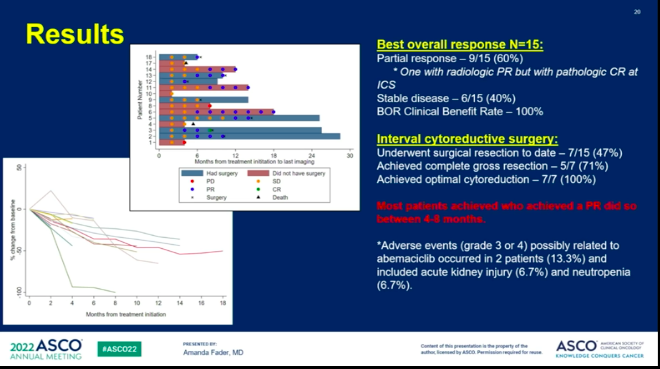
11)A pilot phase II study of neoadjuvant fulvestrant plus abemaciclib in women with advanced low-grade serous carcinoma.  5522


"Neoadjuvant treatment with fulvestrant and abemaciclib was tolerable and demonstrated unprecedented response and CGR rates in this pilot study."


12) Cervical cancer geographical burden analyzer: An interactive, open-access tool for understanding geographical disease burden in patients with recurrent or metastatic cervical cancer.  5523 


"Our web-based online interactive tool can help with identifying areas with high need of intervention, and inform how access, prevention and new or emerging therapies may potentially change the distribution of r/mCC disease burden"


My last ASCO Annual Meeting post will be the Clinical Science Symposium on Molecular Based Treatment of  Endometrial cancer.


Dee


Every Day is a Blessing!