Monday, March 28, 2016

Our Voices Were Heard at The SGO Annual Meeting

As you know I was not able to attend the SGO Annual meeting in person but followed the research news and announcements on Twitter. Annie Ellis, a friend and fellow ovarian cancer survivor did attend the meeting. In my two previous posts on the meeting, I included a number of her in-person tweets. 

But Annie was more than a research advocate in attendance, she was a co-author of the presentation  "Survivors Acceptance of Treatment Side Effects Evolves as Goals of Care Change over the Cancer Continuum" presented by Dr Melissa Frey, NYU Langone Medical Center.

There are a number of meaningful endpoints in clinical trials - overall survival (OS), Progression Free Survival (PS), patient reported outcomes (PRO) and quality of life (QOL). In September 2015, an FDA workshop was held on alternative endpoints. The study presented at SGO by Dr Frey brought focus on the patients perspective on these endpoints.

Melissa Frey MD, Annie Ellis, Laura Koontz PhD, Savannah Shyne MPH, Jing-Yi Chern MD , Jessica Lee MD and Stephanie Blank MD undertook this study to determine whether survivors’ acceptance of treatment side effects changes over the course of living with the disease (NED, recurrence). To do this, Annie Ellis developed a survey and reached out to the ovarian, primary peritoneal and fallopian tube cancer communities for responses to questions related to treatment side effects and patient goals. Over three hundred women participated in the survey. I was one of those 300 women.

45% of the women had a treatment goal of overall survival
41% of the women had a treatment goal of quality of life
12% of the women had a treatment goal of progression free survival
2% of the women did not respond to the question

In response to the question "What is most meaningful to you"  most women chose either overall survival or ability to engage in daily activities.

The overall response to the questions "When asked what they expected from treatment" appears below.


When you separate out the responses of women who have had a recurrence 16% expected a cure and 53% remission. These findings are significant.

Participants were then asked what side effects they would tolerate to get a cure, remission or stable disease. This slide summarizes those responses.

Looking at just those women who have recurrent disease ( n-162) whose expectation is a cure their responses to what side effects they would accept are presented on this slide.

In conclusion:


I look forward to the development of the survivors' decision tool.

Did you take part in the survey? Were the results what you would have expected?
If you didn't participate, which side effects would you tolerate to get a cure, remission or stable disease?

Thank you Annie and all the co-authors for asking women diagnosed with ovarian cancer to share their expectations with the gynecologic oncology cancer community, for reporting those results to the community and for allowing me to share parts of the presentation with my readers.


Dee
Every Day is a Blessing! Blessed to have engaged ovarian cancer research advocates like Annie Ellis working with researchers dedicated to understanding the needs and expectations of survivors.

Wednesday, March 23, 2016

SGO News via Twitter - March 21-22

I appreciate the use of the #sgomtg hashtag by those advocates, gynecologic oncologists and researchers attending the SGO Annual meeting. It has allowed those of us unable to attend to stay on top of the research that can impact the lives of women with a gynecologic cancer.

This blog will cover tweets from the meeting dates March 21-22, 2016 .
The presentation by Dr Frey will be covered in a separate blog post.

You may find more information on enhanced recovery pathways in this journal article. (Enhanced Recovery in Gyneocologic Surgery http://www.ncbi.nlm.nih.gov/pmc/articles/PMC3913481/ )


CSC= cancer stem cell

Thank you to all the researchers who consider the needs of their patients as they develop better treatments, detection tests and a cure.

Dee
Every Day is a Blessing! 

Monday, March 21, 2016

SGO News via Twitter - March 19-20

Since I was unable to go to San Diego for this year's annual  SGO ( Society of Gynecologic Oncologists) meeting, I've been following the meeting's hashtag #sgomtg on Twitter instead.
Here are the tweets I favorited for the March 19-20th. 
ctDNA - Circulating DNA(https://www.genome.gov/27556716)


SNP = single-nucleotide polymorphism ("most common sequence variation in the human genome is the stable substitution of a single base" (http://www.ncbi.nlm.nih.gov/pmc/articles/PMC2410167/)

I appreciate the ability to have interactions with the gyn oncs and other advocates attending the meeting.

Check back on Wednesday for the tweets I found most interesting for the last two days of the meeting.

Dee
Every Day is a Blessing!

Thursday, March 17, 2016

ASCO's The State of Cancer Care in America (2016) and Clinical Cancer Advances

I have been busy spending time with family the past few weeks. The blog posts should be more regular going forward. Thanks for understanding. 

ASCO ( American Society of Clinical Oncology) produces a number of important reports each year of interest to survivors, advocates and caregivers.

The State of Cancer Care in America 2016  reports on the trends in oncology care in the US. The report found that there is a  shortage of oncologists in rural areas, there remains inconsistent insurance coverage for cancer patients and the cost of cancer care continues to rise.
Below is an infographic which summarizes the information and recommendations made in the report. You may read the full report here.


The second report of importance to survivors is Clinical Cancer Advances 2016. For the past 10 years, ASCO has been producing this annual report. Earlier this year ASCO asked advocates and survivors to share how advances in research impacted their lives. You may read the report here.  I was honored to have my story chosen to appear in this year's report . You may find it on Page 41 ( 43 in a pdf reader).

Dee
Every Day is a Blessing!


Monday, February 29, 2016

In the News: Talc

Last week we learned that a Missouri jury awarded the family Jacqueline Fox $10 million of actual damages and $62 million of punitive damages.  The information spread rapidly among Ovarian Cancer survivors. Many posted how they used the product for years. Some shared the information they found presented at the trial such as this letter  which discusses industrial exposure.

After reading so many responses to posts about the lawsuit award in social media and having questions myself (Shouldn't the number of women diagnosed with ovarian cancer be higher if Talc caused the disease? How does the talc affect the ovary to cause cancer? How does the talc affect the ovary when it inside the body not a surface organ?)

I delved further.

Study 1: Perineal Talc Use and Ovarian Cancer :A Critical Review

One of the thorough reviews of talc and ovarian cancer I ran across was this article published in 2008 by Muscat - Perineal Talc Use and Ovarian Cancer :A Critical Review.  (Perineal = cosmetic talc)

In the early 1970's the lung cancer asbestos link was being studied. One  asbestos study using guinea pigs  (1969) showed asbestos in the animal's ovaries.  While limited data in another study showed an increase in mortality rates due to Ovarian cancer for women who worked in the asbestos industry in another study ( 1982) showed. So talc became suspect as a cause of ovarian cancer. Please not that a study done in 2008 showed no increase risk for those working in the asbestos industry.

Is Talc the same as Asbestos? "Asbestos is morphologically (form and structure) distinct from talc and belongs to different silicate mineral groups and subgroups." In other words, Talc which is a member of a different silica group does not behave the same ("a mineral’s fibrous pattern of growth") as asbestos.Thinking along these lines carbon is the same in coal and a diamond it is all how the atoms are arranged.

How does Talc cause cancer?" "Asbestos fibers in the lung initiate an inflammatory and scarring process, and it has been proposed that ground talc, as a foreign body, might initiate an inflammatory response." We are not sure of the bodies response to talc although the formation of ANTI-MUC1 antibodies when the body has been exposed to talc has been proposed in the past.

How does Talc enter the ovaries?"Perhaps the most fundamental unanswered question on perineal dusting is whether powder applied to skin surfaces surrounding the external genitalia actually enter the adult female genital tract. It is uncertain whether dusting contaminates the vagina or cervix and if so under what hygienic conditions. The issue of particle retrograde migration from the cervix to the ovaries assumes that talc particles migrate upwards against both gravity and the downward flow of vaginal mucous and menstrual fluids." ..."In early studies, it was assumed that the vagina was the route of exposure, although as noted previously occupational studies indicated that inhaled particles could migrate from the lungs to the ovaries."
A study of silica in ovaries by Heller showed "Some samples that had no measurable talc counts were obtained from women who reported regular talc dusting, whereas other samples with high concentrations were obtained from women who reported no genital talc use."

The conclusion section of the Muscat study, states,  "lifetime whole body exposure experiments in female laboratory rats found that ovarian tissue was not contaminated with talc and that ovarian tumor incidence was not increased (Boorman and Seely, 1995). "...  "In addition, inhaled talc in mining and milling operations is not associated with increased pulmonary tumors. IARC classified inhaled talc that does not contain asbestos fibers as a group 3 carcinogen (e.g. inadequate evidence in humans), and the likelihood that talc could selectively induce ovarian cancer and not lung cancer, and at exposure concentrations presumably orders of magnitude lower than that in occupational settings needs to be weighed."

Study 2: Perineal Powder Use and Ovarian Cancer

The second study I read was Perineal Powder Use and Ovarian Cancer by Houghton and others published in 2014. This study looked retrospectively at data from the Women’s Health Initiative Observational Study cohort. The women self-reported talc use (genitals, sanitary napkins, or diaphragms) and duration of use. There were over 61,000 women in the study. 

The authors concluded  "Ever use of perineal powder was not associated with risk of ovarian cancer compared with never use. Individually, ever use of powder on the genitals, sanitary napkins or diaphragms was not associated with risk of ovarian cancer compared with never use, nor were there associations with increasing durations of use." 

So where do we go from here?  Is there an increase risk of ovarian cancer?

Audra Moran, President and CEO of Ovarian Cancer Research Fund Alliance said  "The fact remains that the science is inconclusive about increased risk of ovarian cancer to women using talcum powder." 

 Dee

Every Day is a Blessing!

Wednesday, February 24, 2016

Spring Ovarian Cancer Awareness Walks

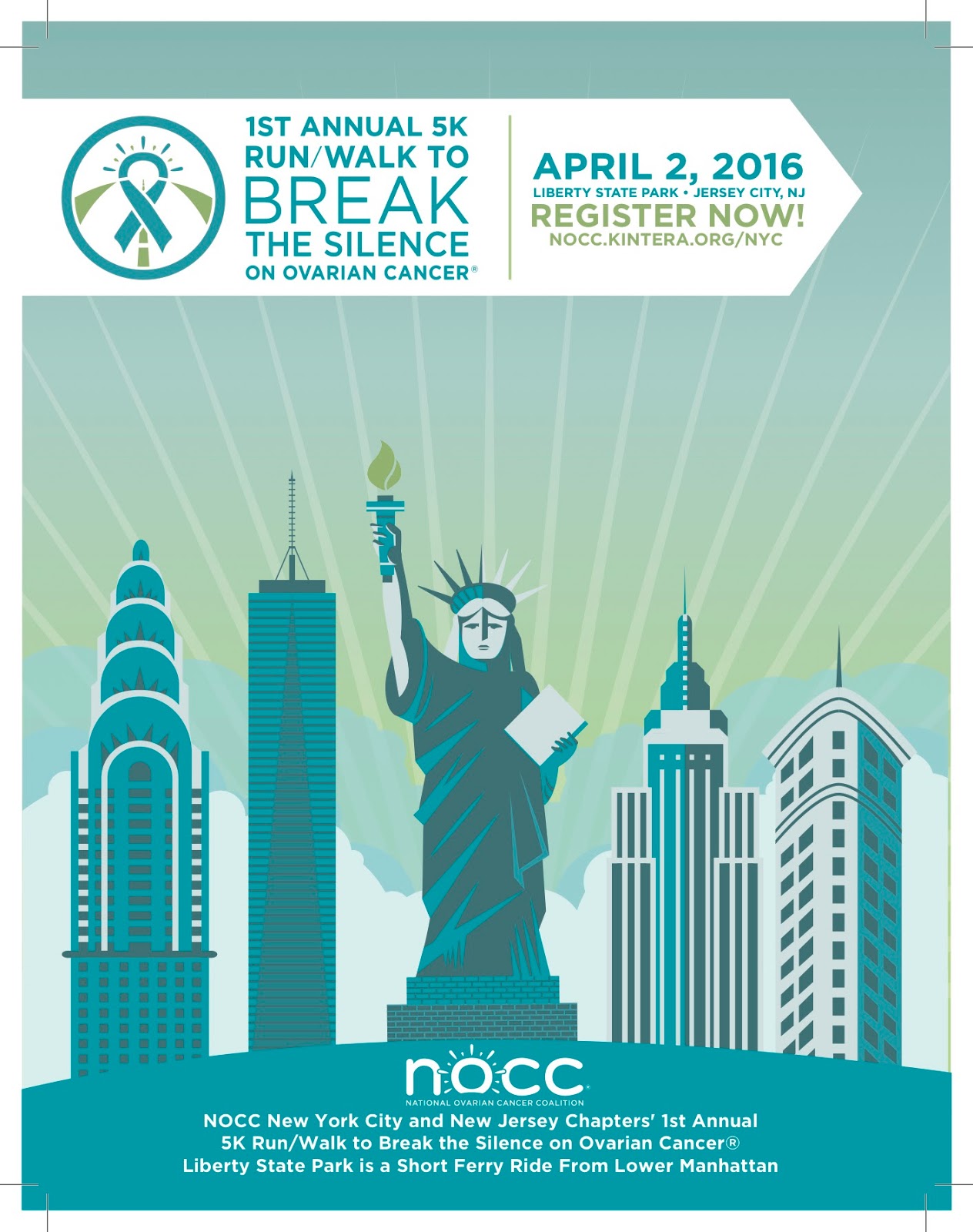
It's never to early to plan how you can help raise awareness and funds for ovarian cancer research. Here is information on two ovarian cancer awareness and fundraising events taking place in my area this spring.

1st Annual 5K Run/Walk to Break the Silence
NOCC NY + NJ 
April 2, 2016
Liberty State Park
Click here to register. Can't make it donations are accepted.


Sandy Rollman Ovarian Cancer Foundation 
12th Annual Sandy Sprint 5K/10K and Canine Sprint
April 23, 2016
Philadephia Museum of Art
Click here to register. Can't make it register as a Sleepwalker!

I appreciate the work our local awareness organizations do to raise awareness and especially the funds they raise to support ovarian cancer research.

Dee
Every Day is a Blessing!

Thursday, February 11, 2016

An Amazing Advocate and Friend

I hated opening my e-mail on Monday afternoon. It's title was simply, "Carole". I knew before I opened it what it would say. Carole had been in hospice the past few weeks. She passed away on Sunday, February 7th, her 60th birthday. She had thrived 9 years after her initial ovarian cancer diagnosis.

Carole was more than just another women with ovarian cancer, she was my friend. We first met at the gyn cancer networking group at the Cancer Support Community of Central NJ. We talked family, BRCA mutations, gynecologic oncologists, awareness and the latest research. We both served on the Board of the Kaleidoscope of Hope Foundation (KOH). Carole was serving in the role of President when she passed away.

Our paths intersected once more when she and I volunteered with the Cancer Hope Network. She loved sharing her story and supporting newly diagnosed women especially those with the BRCA mutations.

She was a wife, mother, teacher and had dedicated herself to raising awareness of ovarian cancer among women in NJ as well as raising funds for research. She loved to travel.  Carole had traveled the world -Europe, South America, Asia. Her home living room was decorated with beautiful Asian works of art.

She thrived as she lived with cancer and was an inspiration to so many. "She never let illness slow her down and ended her battle, as always, on her own terms. " You may read more about her here and on the KOH website here.

Those who advocated along side her will be honored to continue her work raising awareness and supporting research to find a cure. Carole made an impact on my life and I will miss her. Donations in her memory may be made to KOH on their website

Dee
Every Day is a Blessing! I was blessed to have Carole in my life.